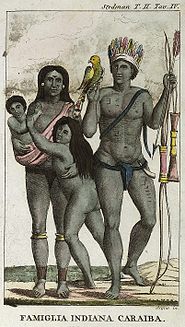
Spanish exploitation of Trinidad's indigenous people for pearl fisheries led to demographic catastrophe.
Trinidad and Tobago
Political
Exploitation
4 min read
Updated By: History Editorial Network (HEN)
Published:
Updated:
During the early 16th century, the Spanish Crown sought to consolidate its control over new territories in the Caribbean, including Trinidad. Spanish colonizers were eager to exploit the natural resources, particularly the valuable pearl fisheries located in nearby waters. To facilitate the extraction of these resources, they needed a substantial labor force.
The indigenous populations of Trinidad, mainly the Lokono and Kalinago people, known to the Spanish as 'Arawaks' and 'Caribs' respectively, became targets. By labeling the Kalinago as 'Caribs,' the Spanish invoked the 1503 Spanish Royal Decree allowing the capture and enslavement of any indigenous people deemed 'Caribs.' This decree framed the Kalinago as hostile and lawless, justifying their enslavement under the guise of reducing threats and bringing Christianity.
The forced labor of these indigenous people enabled the Spanish to exploit the pearl fisheries more effectively. Many indigenous were compelled to dive for pearls under dangerous conditions, leading to significant population decline due to overwork, brutality, and exposure to European diseases. The Spanish colonization policies resulted in a demographic catastrophe for local communities, with estimates suggesting a dramatic reduction in the indigenous population within a few decades.
The declaration and subsequent actions had long-term ramifications, contributing to the cultural and demographic transformation of the region. It marked the beginning of significant shifts in societal structures, with the gradual replacement of indigenous labor by African slaves, leading to the complex, multi-ethnic society of modern-day Trinidad and Tobago.
#IndigenousHistory #ColonialExploitation #CulturalChange #HumanRights #HistoricalImpact #MoofLife

Explore the Life Moments of
 AI Twin