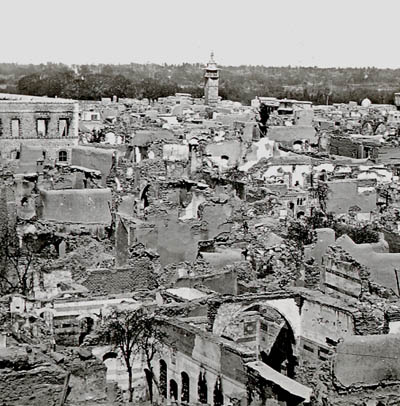
Tragic Attack on Christians in Damascus by Ottoman Soldiers
Syria

10 min read
Updated By: History Editorial Network (HEN)
Published:
On July 1, 1860, a horrific massacre of Christians occurred in Damascus, Syria, during a period of intense sectarian violence in the Ottoman Empire. This massacre, carried out primarily by local Muslim factions and with the complicity of Ottoman forces, resulted in the deaths of thousands of Christian residents in the city. The massacre was part of a broader wave of violence that had swept across the region, particularly in Mount Lebanon, and highlighted the deep religious and ethnic tensions within the Ottoman Empire during the mid-19th century.
Background: Sectarian Tensions in the Ottoman Empire
The mid-19th century was a period of significant upheaval within the Ottoman Empire, which was grappling with internal decay, external pressures, and growing nationalist movements among its diverse populations. In the region of Mount Lebanon, sectarian tensions between the Maronite Christians and the Druze community had been simmering for decades, exacerbated by social, economic, and political disparities.
In 1840, following a brief period of Egyptian control over Syria and Lebanon, the Ottoman Empire regained control of the region. However, the return of Ottoman rule did little to ease the sectarian tensions. The situation deteriorated further in the 1850s, with the growing influence of European powers, particularly France, which saw itself as the protector of the region’s Christians, and Britain, which had interests in supporting the Druze.
By 1860, these tensions erupted into full-scale violence. In Mount Lebanon, fighting broke out between the Druze and the Maronites, leading to widespread massacres. The violence soon spread to other parts of Syria, including the city of Damascus, where Christians and Muslims had lived together in relative peace for centuries.
The Massacre in Damascus
The massacre in Damascus began on July 9, 1860, after reports of the violence in Mount Lebanon had reached the city. Tensions in Damascus had already been high, fueled by rumors and fear of Christian retribution. A mob of local Muslims, incited by radical clerics and local leaders, began attacking Christian neighborhoods in the city.
The violence quickly escalated, with homes, churches, and monasteries being looted and burned. Thousands of Christians were killed in the streets and in their homes, often with horrific brutality. Women, children, and the elderly were not spared. The destruction was so extensive that entire Christian quarters were left in ruins.
The role of the Ottoman authorities during the massacre was highly controversial. While some local officials and military leaders tried to maintain order, many others either turned a blind eye or actively participated in the violence. The Ottoman governor of Damascus, Ahmed Pasha, was later accused of failing to protect the Christian population and of allowing the massacre to occur.
International Response and Aftermath
The massacre in Damascus, along with the violence in Mount Lebanon, shocked the international community. News of the atrocities spread quickly, leading to widespread condemnation, particularly from European powers like France, Britain, and Russia. The massacre became a focal point for humanitarian concern, with Christian missionaries and diplomats demanding protection for the region’s Christian communities.
Under pressure from European powers, the Ottoman Empire took steps to address the violence. Sultan Abdulmejid I dispatched a military force to restore order in Syria and appointed a new governor, Fuad Pasha, who arrived in Damascus in August 1860. Fuad Pasha acted swiftly, arresting and executing many of those responsible for the massacre, including local officials who had failed to protect the Christian population.
The Ottoman government also agreed to reforms aimed at protecting religious minorities, and France, invoking its role as a protector of Christians in the Ottoman Empire, sent troops to Lebanon to help restore order. The violence and the subsequent European intervention led to the creation of the autonomous Mount Lebanon Mutasarrifate in 1861, a province governed by a non-Lebanese Christian appointed by the Ottoman sultan.
Legacy and Impact
The massacre of Christians in Damascus in 1860 left a deep scar on the city's history and the collective memory of its people. The events highlighted the fragility of the Ottoman Empire’s control over its diverse populations and the dangers of sectarian violence. It also underscored the growing influence of European powers in the region, which would continue to shape the political landscape of the Middle East in the decades to come.
For the Christian community in Damascus, the massacre was a traumatic event that significantly reduced their numbers and led to a lasting sense of insecurity. It also contributed to the wider narrative of Christian persecution in the Ottoman Empire, which would be invoked in later conflicts and discussions about the empire’s treatment of its religious minorities.
The 1860 massacre is remembered as one of the most tragic episodes in the history of Damascus and serves as a reminder of the devastating consequences of sectarian hatred and violence.
#MomentsOfLife #MoofLife_Moment #MoofLife #Syria #DamascusMassacre #OttomanEmpire #SectarianViolence #MiddleEasternHistory
Primary Reference
1860 civil conflict in Mount Lebanon and Damascus - Wikipedia

Explore the Life Moments of
 AI Twin