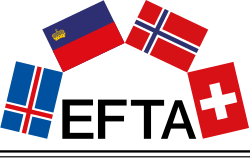
Sweden joined the European Free Trade Association (EFTA)
Sweden


'/%3e%3c/g%3e%3cuse xlink:href='%23d' x='45.714'/%3e%3cuse xlink:href='%23e' transform='matrix(-1 0 0 1 479.792 0)'/%3e%3cg id='f' fill='%23fff'%3e%3cpath fill='%23039' d='M232.636 202.406v.005c0 2.212.85 4.227 2.212 5.69 1.365 1.466 3.245 2.377 5.302 2.377 2.067 0 3.944-.905 5.303-2.365 1.358-1.459 2.202-3.472 2.202-5.693v-10.768l-14.992-.013-.028 10.766'/%3e%3ccircle cx='236.074' cy='195.735' r='1.486'/%3e%3ccircle cx='244.392' cy='195.742' r='1.486'/%3e%3ccircle cx='240.225' cy='199.735' r='1.486'/%3e%3ccircle cx='236.074' cy='203.916' r='1.486'/%3e%3ccircle cx='244.383' cy='203.905' r='1.486'/%3e%3c/g%3e%3cuse xlink:href='%23f' y='-26.016'/%3e%3cuse xlink:href='%23f' x='-20.799'/%3e%3cuse xlink:href='%23f' x='20.745'/%3e%3cuse xlink:href='%23f' y='25.784'/%3e%3c/svg%3e)
Global Trade
Economic Development
6 min read
Updated By: History Editorial Network (HEN)
Published:
Updated:
On 3 May 1960, Sweden officially became a founding member of the European Free Trade Association (EFTA), as the Stockholm Convention, signed four months earlier on 4 January 1960, came into force. This date marked the beginning of a new chapter in European economic relations and confirmed Sweden’s commitment to regional trade cooperation while preserving its policy of neutrality and independence in political matters.
Sweden, along with six other countries—Austria, Denmark, Norway, Portugal, Switzerland, and the United Kingdom—helped establish EFTA as a counterbalance to the European Economic Community (EEC). The EEC, formed by the “Inner Six” (Belgium, France, Italy, Luxembourg, the Netherlands, and West Germany) in 1957, had a vision for deeper political and economic integration. However, nations like Sweden sought economic benefits without the supranational commitments that the EEC entailed. EFTA provided the perfect alternative: a framework for free trade in industrial goods, with less political integration and more respect for national sovereignty.
Sweden’s economy in the post-war period was expanding rapidly, with a strong industrial base and an increasing interest in securing export markets. Membership in EFTA offered Sweden access to a larger market, allowing it to compete more effectively across Europe while maintaining its non-aligned foreign policy stance during the Cold War. The EFTA arrangement suited Sweden’s goals, focusing on the removal of tariffs and trade barriers among member states without requiring the common external tariff or political union that the EEC demanded.
Over the decades, Sweden benefited from growing trade volumes with its EFTA partners, particularly in sectors like machinery, vehicles, paper, and chemicals. Yet as European integration deepened and the EEC evolved into the European Union (EU), Sweden began to reconsider its position. By the early 1990s, the global economic landscape and geopolitical shifts—especially the end of the Cold War—prompted Sweden to pursue deeper integration with the European mainstream.
As a result, Sweden left EFTA and joined the European Union in 1995, following a national referendum in 1994 where a majority voted in favor of EU membership. Nevertheless, Sweden’s time in EFTA laid important groundwork for its international trade policy, showcasing its commitment to multilateralism, regional cooperation, and economic openness.
Thus, 3 May 1960 is more than a technical accession date—it marks Sweden’s strategic alignment with a vision of Europe grounded in free trade and pragmatic cooperation, setting the stage for its evolving role in European economic structures throughout the late 20th century.
#MomentsOfLife #MoofLife_Moment #MoofLife #EFTA #SwedishHistory #TradeCooperation #EuropeanIntegration #1960sEurope

Explore the Life Moments of
 AI Twin