Decline of the Funj Sultanate in Sennar
Sudan
Political
5 min read
Updated By: History Editorial Network (HEN)
Published:
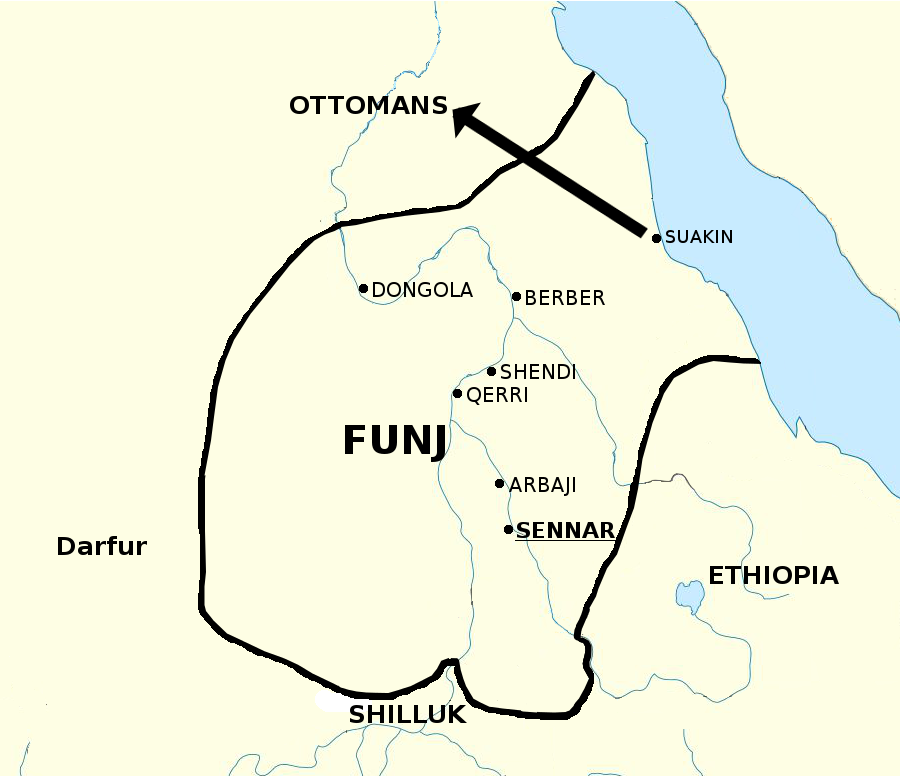
The Funj Sultanate, centered in Sennar, was a powerful entity in the African region known today as Sudan. Its political and military influence had been a significant force since its establishment in the early 16th century. However, this period witnessed major political changes that culminated in the eventual collapse of the sultanate.
The decline of the Funj Sultanate was gradual, marked by internal disarray and external pressures. The administrative structure weakened due to infighting among ruling elites and decreasing central control over outlying areas. The kingdom's fragmented nature made it susceptible to external threats, particularly from the expanding power of Egypt under the rule of Muhammad Ali Pasha.
Egypt, under Muhammad Ali's leadership, was undergoing a period of expansion and modernization. Muhammad Ali sought to increase his influence and control over trade routes and resources, particularly in the region of Sudan. The Funj Sultanate's weakened state presented an opportunity for Egypt to exert dominance. Egyptian forces, well-equipped and organized, faced little resistance from the fragmented and underprepared Funj army.
The military campaign led by Muhammad Ali’s forces was swift and decisive. The Funj Sultanate was unable to muster a significant defense against the Egyptian advance. Key locations, including the capital Sennar, were quickly captured. The once-powerful sultanate fell, marking the end of Funj dominance in the region and the beginning of Egyptian rule over Sudan.
The collapse had substantial impacts on the region’s political and social structures. Under Egyptian rule, significant changes were implemented which altered the traditional power dynamics. The imposition of new administrative practices, introduction of different economic policies, and integration into the broader Egyptian empire transformed the region's landscape. This period also laid the groundwork for subsequent British colonization of Sudan, linking local histories to broader imperial narratives.
The end of the Funj Sultanate represents a critical moment in Sudanese history, signifying the shift from localized rule to external domination. This transition period describes the geopolitical restructuring that had long-term implications for the region's future.
#SudanHistory #FunjSultanate #EgyptianConquest #PoliticalTransition #HistoricalImpact #MoofLife

Explore the Life Moments of
 AI Twin