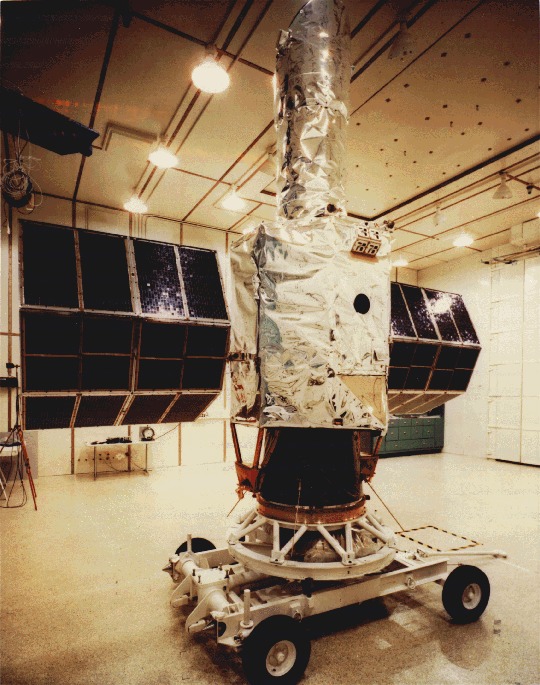
The International Ultraviolet Explorer (IUE)
High Earth Orbit (geosynchronous orbit)
Space Exploration
Astronomy
Astrophysics
4 min read
Updated By: History Editorial Network (HEN)
Published:
Updated:
On 26/01/1978, the International Ultraviolet Explorer (IUE) was launched into space, becoming the first high-Earth orbit astronomical satellite dedicated primarily to ultraviolet (UV) spectroscopy. The mission was a joint effort between NASA, the European Space Agency (ESA), and the United Kingdom’s Science Research Council (SRC), marking an important step in international collaboration in space-based astronomy.
The IUE was placed into an elliptical geosynchronous orbit, allowing it to maintain continuous communication with ground stations and enabling real-time control by astronomers. Scientists operated the telescope remotely from facilities in Maryland, United States, and Madrid, Spain, using a system that functioned similarly to ground-based observatories. This operational model allowed researchers to schedule observations and adjust experiments directly, increasing flexibility and efficiency in data collection.
Designed for an initial mission duration of three years, the IUE far exceeded expectations by remaining operational for more than 18 years, until it was shut down on 30/09/1996. Over its lifetime, the observatory recorded more than 104,000 ultraviolet spectra of a wide range of celestial objects, including planets, stars, nebulae, and distant quasars. These observations contributed to studies of stellar evolution, interstellar matter, and the chemical composition of astronomical objects.
The IUE mission demonstrated the value of long-duration space observatories and established a model for collaborative, user-driven space astronomy. Its success influenced the development of later missions such as the Hubble Space Telescope and other space-based observatories designed to explore different regions of the electromagnetic spectrum.
#mooflife
#MomentOfLife
#InternationalUltravioletExplorer
#Nasa
#Esa
#UltravioletAstronomy
#SpaceObservatories
Primary Reference
International Ultraviolet Explorer

Explore the Life Moments of
 AI Twin