NASA Artemis II Launches First Crewed Lunar Flyby Mission
Kennedy Space Center, Florida, United States
MoonMission
NASA
6 min read
Updated By: History Editorial Network (HEN)
Published:
Updated:
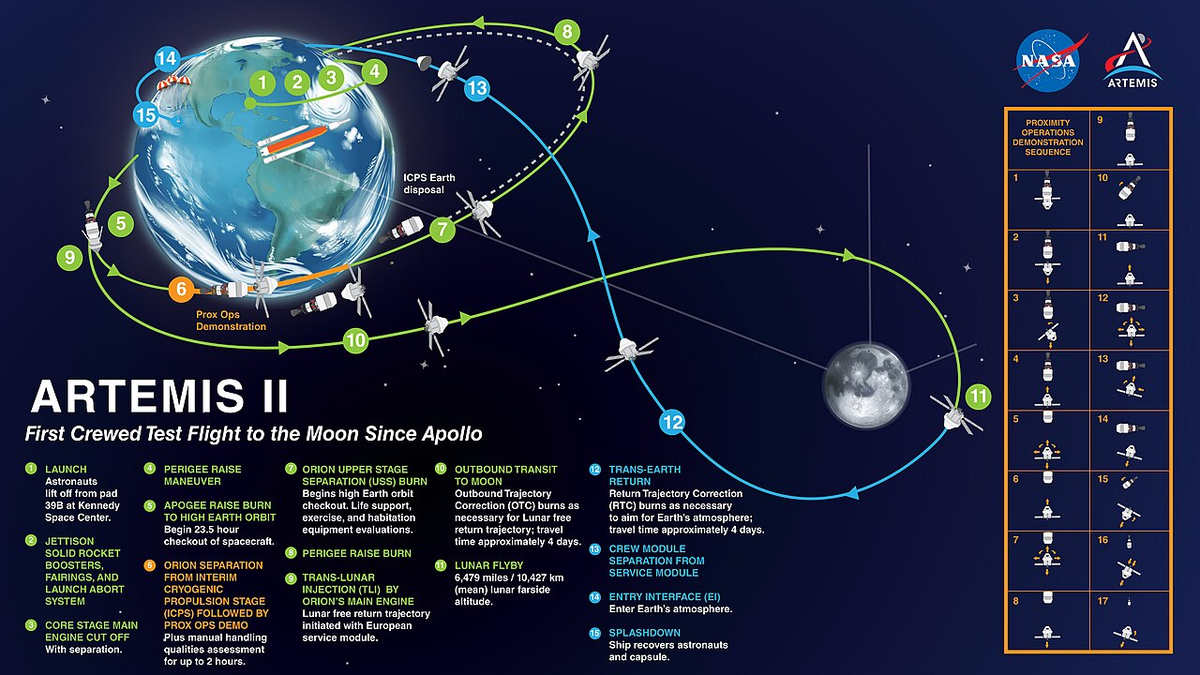
NASA successfully launched the Artemis II mission on 01/04/2026 at 6:35:12 p.m. EDT (22:35:12 UTC) from Launch Complex 39B at the Kennedy Space Center in Florida, sending four astronauts on a planned 10 day crewed test flight around the Moon. The mission uses NASA’s Space Launch System rocket and Orion spacecraft to evaluate deep space systems with humans aboard. The crew includes Commander Reid Wiseman, Pilot Victor Glover, and Mission Specialist Christina Koch from NASA, along with Mission Specialist Jeremy Hansen of the Canadian Space Agency. Artemis II marks the first crewed mission to travel beyond low Earth orbit since Apollo era lunar flights and is designed to validate life support, navigation, communication, and propulsion systems for future lunar missions.
The crew also represents several firsts in human spaceflight. Victor Glover is the first person of color to travel beyond low Earth orbit, Christina Koch is the first woman to travel to the Moon’s vicinity, and Jeremy Hansen is the first non United States astronaut assigned to a lunar mission. Following launch, Orion entered Earth orbit before mission controllers prepared the spacecraft for departure toward the Moon. The spacecraft’s service module engine performed a translunar injection burn on 02/04/2026, sending the crew out of Earth orbit and onto a free return trajectory toward the Moon. NASA confirmed this burn marked the first time since 1972 that astronauts departed Earth orbit for a lunar flyby.
During the outbound journey, Artemis II reached the halfway point between Earth and the Moon on 04/04/2026. The spacecraft continued through cislunar space toward a planned lunar flyby on 06/04/2026. Orion is expected to pass approximately 4,000 to 6,000 miles above the lunar surface, during which communications will briefly drop out as the Moon blocks signals between Earth and the spacecraft. At maximum distance, the crew is projected to travel about 252,757 miles from Earth, surpassing the previous human spaceflight distance record set by Apollo 13.
After the lunar flyby, Orion will use the Moon’s gravity to redirect the spacecraft back toward Earth on a return trajectory. The mission is scheduled to conclude with splashdown in the Pacific Ocean off the coast of San Diego on 10/04/2026 at approximately 8:00 p.m. EDT, completing the full mission duration of about 10 days. The flight serves as the first crewed test of Orion in deep space ahead of future Artemis missions planned to send astronauts into lunar orbit and eventually land crews on the Moon.
#ArtemisII
#NASA
#Orion
#SLS
#Spaceflight
#LunarFlyby
#MoonMission
Primary Reference
Artemis II

Explore the Life Moments of
 AI Twin