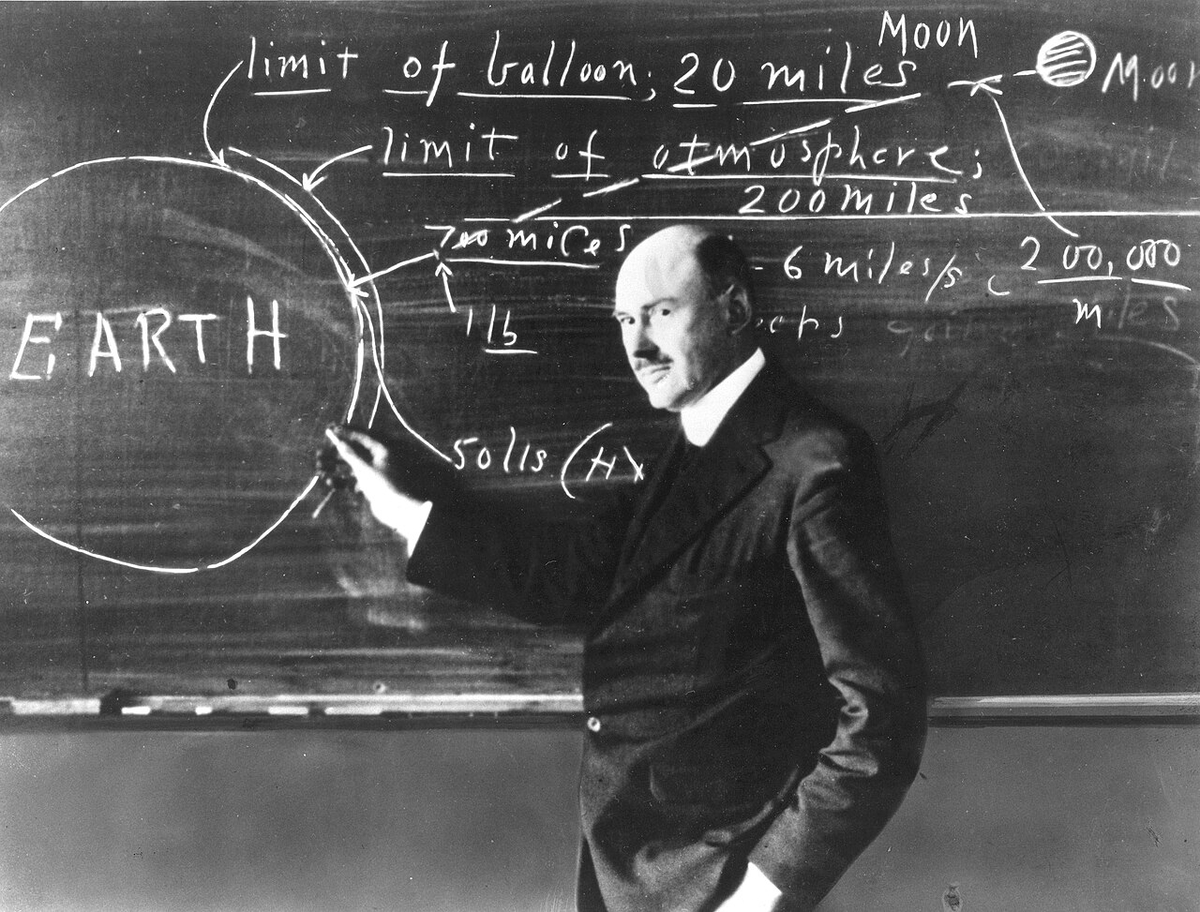
Goddard's influential paper on rocketry
United States
Aerospace Engineering
Rocketry
Physics
4 min read
Updated By: History Editorial Network (HEN)
Published:
Updated:
In 1919, American physicist Robert H. Goddard published A Method of Reaching Extreme Altitudes, a detailed scientific paper that outlined the principles required for rocket-powered flight beyond Earth’s atmosphere. Released by the Smithsonian Institution, the work provided one of the earliest comprehensive analyses of how rockets could be used to reach high altitudes and potentially travel into space.
In the paper, Goddard applied mathematical and physical principles to calculate rocket performance, including velocity, fuel consumption, and the effects of gravity and atmospheric resistance. He demonstrated that rockets could function efficiently in a vacuum, countering the common misconception that propulsion required air to push against. His analysis built upon earlier theoretical work and extended it into practical engineering considerations, offering a clearer path toward real-world implementation.
Goddard also explored the potential of liquid fuels, which he identified as more effective than solid propellants for achieving higher output and control. He discussed the possibility of reaching extreme altitudes and even suggested that rockets could one day be used to send instruments to the Moon. These ideas were supported by calculations showing that sufficient velocity could be achieved with proper fuel and design.
Despite its scientific rigor, the publication initially drew public skepticism, particularly due to misunderstandings about his discussion of reaching the Moon. However, the paper became an important reference for later researchers and engineers working on rocket development. It directly influenced Goddard’s own experimental work in the 1920s and contributed to the broader advancement of astronautics.
#mooflife
#MomentOfLife
#RobertGoddard
#Rocketry
#SpaceExploration
#Liquid-fueledRockets
#AerospaceEngineering
Primary Reference
Robert H. Goddard

Explore the Life Moments of
 AI Twin