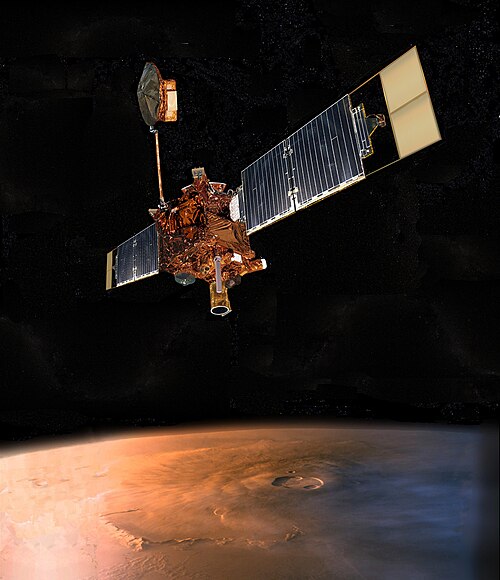
First spacecraft to use aerobraking to enter orbit
Mars orbit
Space Exploration
Mars Missions
Aerospace Technology
5 min read
Updated By: History Editorial Network (HEN)
Published:
Updated:
On 17/09/1997, NASA’s Mars Global Surveyor (MGS) spacecraft performed its first aerobraking maneuver in the Martian atmosphere, marking the first time this technique was used as a primary, mission-planned method for orbital adjustment. The maneuver took place shortly after the spacecraft entered orbit around Mars, initiating a critical phase designed to reshape its trajectory for long-term scientific operations.
Aerobraking allowed MGS to transition from a highly elliptical capture orbit into a lower, near-circular mapping orbit without relying heavily on onboard fuel. The spacecraft achieved this by dipping into the upper layers of Mars’ atmosphere at each closest approach, or perigee. During these passes, its solar panels acted as aerodynamic surfaces, generating drag that gradually reduced the spacecraft’s apoapsis, or farthest orbital point. This process repeated over many orbits, steadily refining the spacecraft’s path.
Although aerobraking had been previously demonstrated by NASA’s Magellan mission at Venus in 1993, Mars Global Surveyor was the first mission to depend on it as an essential operational phase. Shortly after launch, engineers identified damage to one of the spacecraft’s solar panels, which required adjustments to the aerobraking strategy. As a result, the process was carried out more cautiously than originally planned, extending the aerobraking phase until February 1999.
The successful completion of aerobraking enabled Mars Global Surveyor to enter its intended low-altitude orbit, from which it conducted detailed mapping of the Martian surface, atmosphere, and gravitational field. The mission went on to return extensive data, including high-resolution images and topographic measurements, contributing to a clearer understanding of Mars’ geology and climate.
Why This Moment Matters:
The use of aerobraking as a core mission strategy demonstrated a practical way to conserve fuel for planetary missions, influencing the design of subsequent Mars orbiters and expanding options for long-duration exploration.
#mooflife
#MomentOfLife
#MarsGlobalSurveyor
#Aerobraking
#Nasa
#SpaceExploration
#MarsMissions
Primary Reference
Mars Global Surveyor

Explore the Life Moments of
 AI Twin