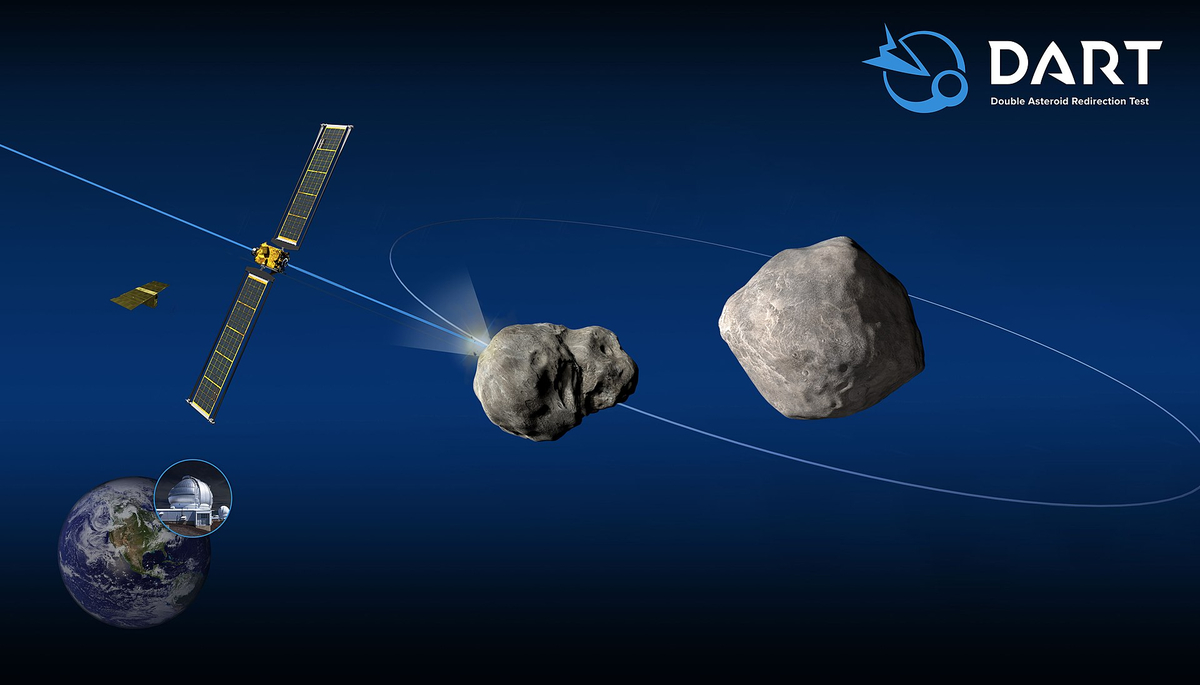
First spacecraft to measurably deflect an asteroid
Dimorphos Moonlet, Didymos Asteroid System, Near-Earth Space
Space Exploration
Asteroid Research
NASA Missions
6 min read
Updated By: History Editorial Network (HEN)
Published:
Updated:
On 26/09/2022, NASA’s Double Asteroid Redirection Test (DART) spacecraft intentionally impacted the asteroid moonlet Dimorphos at a velocity of about 22,500 km/h, marking the first full-scale test of a kinetic impactor for planetary defense. The collision occurred at approximately 23:14 UTC as DART struck Dimorphos, a body about 160 meters in diameter orbiting the larger asteroid Didymos, located roughly 11 million kilometers from Earth at the time. The spacecraft used its onboard DRACO camera to autonomously guide itself during the final approach, transmitting images until seconds before impact. The mission aimed to determine whether a spacecraft could deliberately alter the motion of a celestial body that might otherwise pose a future collision risk to Earth.
The impact targeted Dimorphos rather than Didymos itself, allowing scientists to measure orbital changes by observing how long the moonlet took to orbit its parent asteroid after the collision. Observations from ground-based telescopes and radar confirmed that the impact shortened Dimorphos’s orbital period by about 32 to 33 minutes, reducing it from roughly 11 hours 55 minutes to about 11 hours 23 minutes. This exceeded NASA’s pre-mission success threshold of a 73-second change. The collision ejected a large plume of debris into space, increasing the momentum transfer and contributing to the measured deflection. The event was documented both by DRACO images transmitted by DART and by the Italian Space Agency’s LICIACube, which separated from the spacecraft before impact and captured external images of the ejecta cloud.
Subsequent analysis indicated that the impact not only altered Dimorphos’s orbit around Didymos but also slightly changed the trajectory of the binary asteroid system around the Sun. Researchers reported measurable recoil effects produced by ejecta leaving the surface, which amplified the deflection beyond the spacecraft’s direct momentum. The mission provided real data on asteroid composition, surface structure, and the effectiveness of kinetic impact techniques, supporting future planetary defense planning.
To further study the aftermath, the European Space Agency launched the Hera mission on 07/10/2024 to conduct a detailed survey of the Didymos-Dimorphos system. Hera is designed to measure the crater created by DART, determine the mass of Dimorphos, and refine calculations of momentum transfer. These follow-up observations are intended to validate models of asteroid deflection and improve preparedness for potential future hazardous objects.
#mooflife
#MomentOfLife
#Nasa
#Dart
#AsteroidDeflection
#PlanetaryDefense
#SpaceExploration
Primary Reference
Double Asteroid Redirection Test

Explore the Life Moments of
 AI Twin