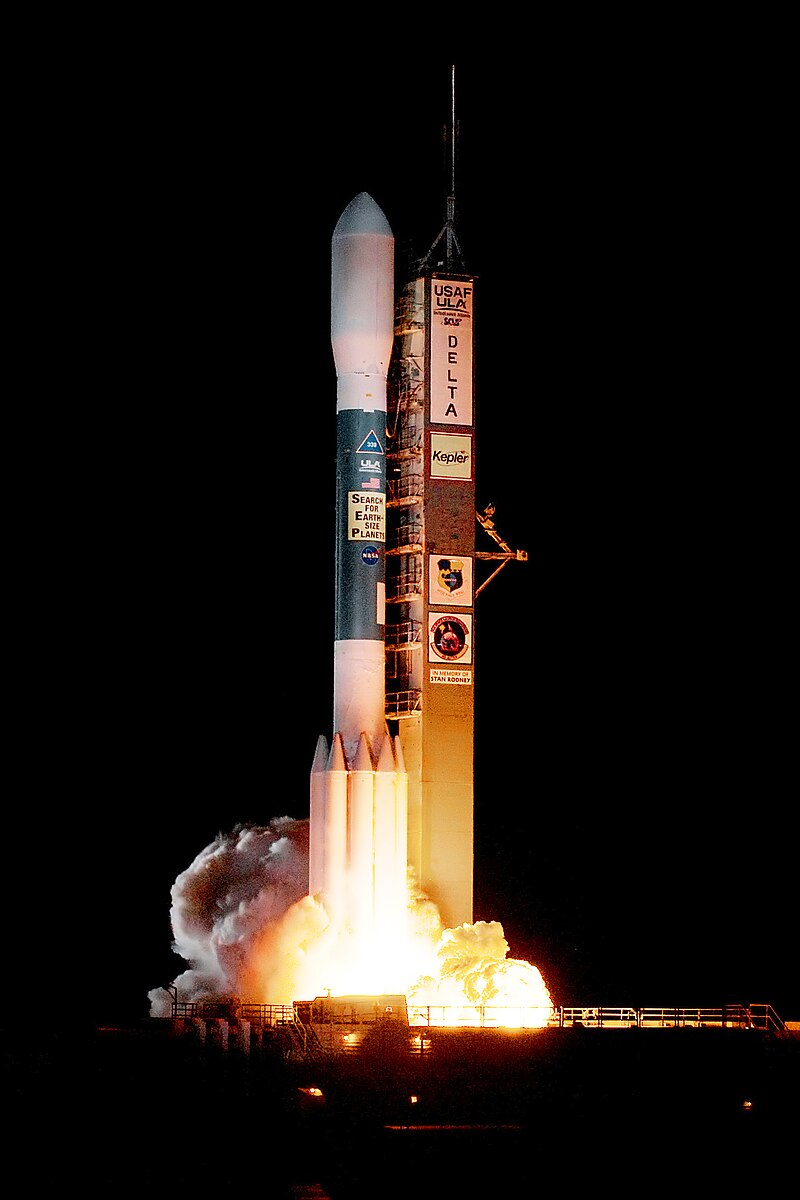
First space telescope for Earth-like exoplanets
Cape Canaveral Air Force Station, Florida, United States
Space Exploration
Astronomy
Exoplanet Research
4 min read
Updated By: History Editorial Network (HEN)
Published:
Updated:
On 06/03/2009, NASA launched the Kepler Space Telescope aboard a Delta II rocket from Cape Canaveral Air Force Station in Florida. The mission was the first spacecraft specifically designed to survey a portion of the Milky Way galaxy to detect Earth sized exoplanets orbiting Sun like stars. After launch, Kepler entered an Earth trailing heliocentric orbit, allowing it to continuously observe a fixed field of about 150,000 stars in the constellations Cygnus and Lyra. This stable viewing geometry enabled long duration monitoring needed to detect small periodic dips in brightness caused by planets passing in front of their host stars.
Kepler used the transit photometry method, measuring tiny decreases in starlight when an orbiting planet crossed the star’s disk. The spacecraft carried a 0.95 meter aperture telescope with a large array of CCD detectors designed for high precision brightness measurements. By repeatedly observing the same stars, Kepler could identify planetary candidates and determine orbital periods and relative sizes. The mission focused on detecting rocky planets in the habitable zone, where temperatures could allow liquid water to exist on a planet’s surface.
The mission produced thousands of exoplanet candidates and confirmed many Earth sized and super Earth worlds. Kepler data revealed that planets are common in the Milky Way and that small planets occur frequently around Sun like stars. The spacecraft’s discoveries included multi planet systems, compact planetary architectures, and planets within habitable zones. Kepler operated in its primary mission until 2013, followed by the extended K2 mission using modified pointing techniques.
The launch on 06/03/2009 marked the beginning of a dedicated space based survey for Earth sized planets, providing statistical measurements of planetary occurrence and shaping future exoplanet exploration missions.
#mooflife
#MomentOfLife
#KeplerMission
#Exoplanets
#Nasa
#SpaceTelescope
#Earth-likePlanets
Primary Reference
Kepler space telescope

Explore the Life Moments of
 AI Twin