First sounding rocket launch from Antarctica
McMurdo Station, Antarctica
Aerospace
Space Exploration
Scientific Research
3 min read
Updated By: History Editorial Network (HEN)
Published:
Updated:
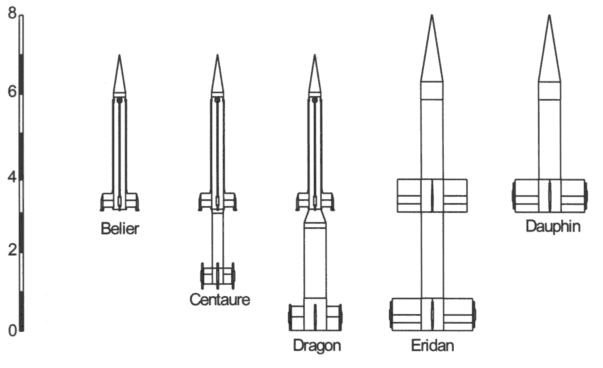
On 26/01/1967, the first sounding rocket launch from Antarctica was successfully carried out, marking the expansion of space and atmospheric research into one of the most remote regions on Earth. The launch took place at McMurdo Station, the United States’ primary research base on the continent, as part of scientific efforts to study the upper atmosphere and near-space environment over the polar regions.
Sounding rockets are suborbital research vehicles designed to carry scientific instruments to high altitudes for short-duration experiments. The Antarctic launch enabled researchers to collect data on atmospheric composition, ionospheric conditions, and auroral activity, which are particularly prominent near the poles due to interactions between Earth’s magnetic field and charged particles from the Sun. Conducting launches from Antarctica provided unique observational advantages, including access to polar atmospheric phenomena not easily studied from other locations.
The mission demonstrated that rocket operations could be conducted in extreme environmental conditions, including low temperatures, strong winds, and logistical isolation. This achievement supported the continued use of Antarctic sites for upper-atmosphere research and contributed to a broader understanding of space weather and its effects on Earth’s environment.
#mooflife
#MomentOfLife
#Antarctica
#SoundingRocket
#DragonRocket
#Dumont-d'urville
#AtmosphericResearch
Primary Reference
Dragon (rocket)

Explore the Life Moments of
 AI Twin