First Solar Sail Mission by Japan
Tanegashima Space Center, Kagoshima, Japan
Space
Technology
Innovation
4 min read
Updated By: History Editorial Network (HEN)
Published:
Updated:
On 21/05/2010 JST, the Japan Aerospace Exploration Agency launched the IKAROS spacecraft from the Tanegashima Space Center, marking the first interplanetary mission to successfully demonstrate solar sail propulsion. The launch occurred aboard an H-IIA rocket, which also carried the Venus climate orbiter Akatsuki. Although the liftoff took place on 20/05/2010 UTC, it was early morning on 21/05/2010 in Japan. After separation, IKAROS began its journey into interplanetary space, deploying its sail as it traveled toward the orbit of Venus.
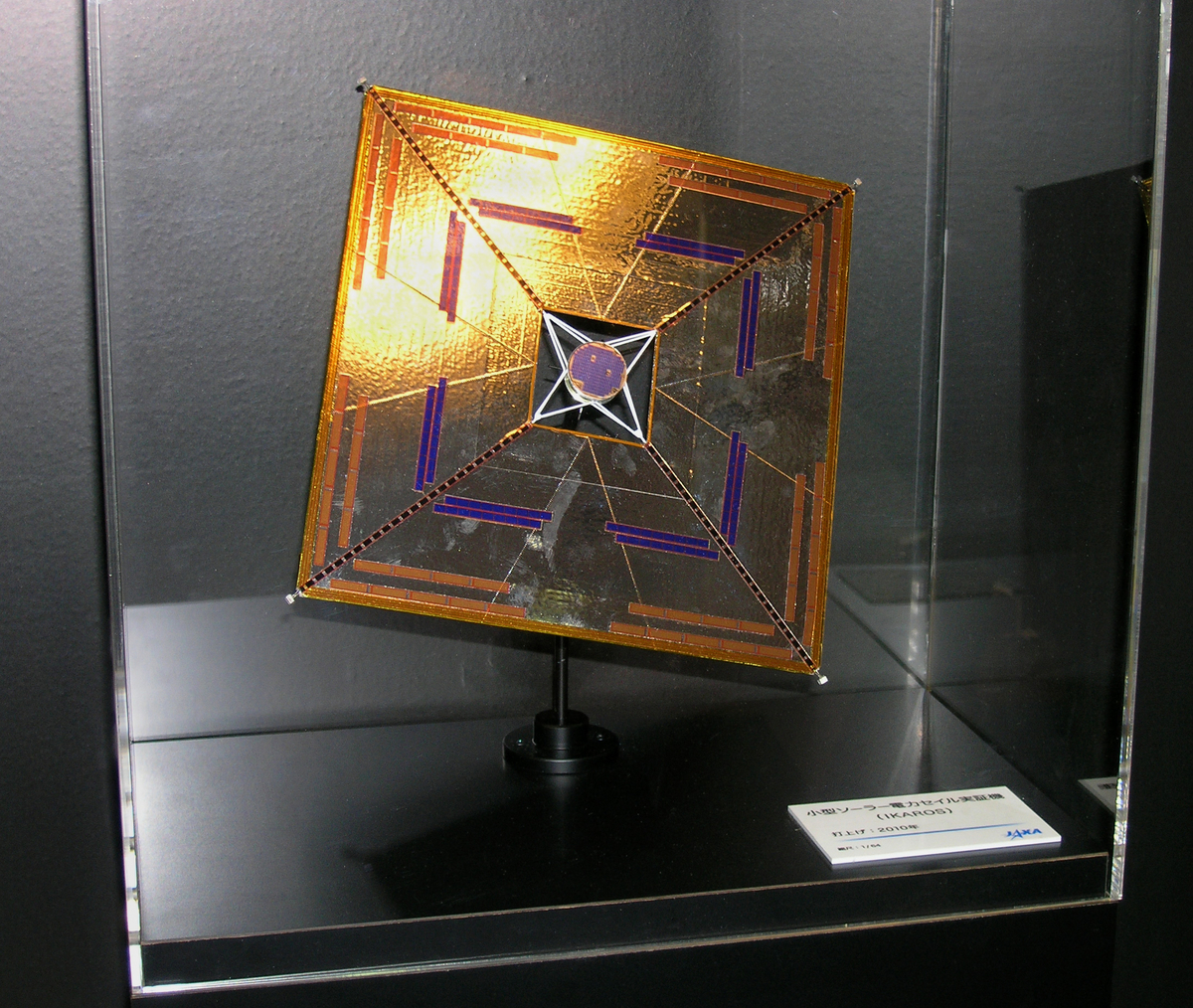
IKAROS, short for Interplanetary Kite craft Accelerated by Radiation of the Sun, used a large square sail made of thin polyimide material measuring about 14 meters on each side. The sail generated propulsion by reflecting sunlight, producing a small but continuous thrust without conventional propellant. The spacecraft successfully deployed the sail in June 2010 and confirmed photon driven acceleration through measured changes in trajectory. Embedded thin film solar cells on the sail also generated electrical power for onboard systems.
The mission demonstrated both solar sail propulsion and attitude control using liquid crystal devices that altered reflectivity across the sail. By adjusting the distribution of solar radiation pressure, IKAROS could control its orientation and trajectory. The spacecraft conducted experiments during its cruise toward Venus, validating navigation techniques for future propellant free propulsion missions.
IKAROS became the first spacecraft to demonstrate controlled solar sail flight in interplanetary space. The mission provided data on sail deployment, photon acceleration, and long duration operation using solar radiation pressure as the primary propulsion method.
#mooflife
#MomentOfLife
#Ikaros
#SolarSail
#Jaxa
#SpaceExploration
#PropulsionTechnology
Primary Reference
IKAROS

Explore the Life Moments of
 AI Twin