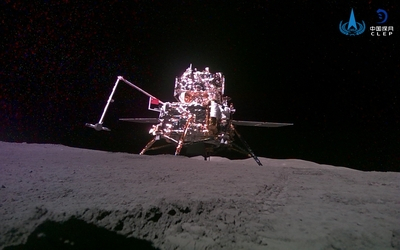
First samples returned from the far side of the Moon
Wenchang Space Launch Site, China; Apollo Crater, South Pole–Aitken Basin, Moon; Inner Mongolia, China
Space Exploration
Lunar Missions
Scientific Research
6 min read
Updated By: History Editorial Network (HEN)
Published:
Updated:
On 25/06/2024, China’s Chang’e 6 mission returned the first samples ever collected from the far side of the Moon, concluding a 53 day robotic mission that targeted the South Pole–Aitken Basin. The return capsule landed in Inner Mongolia, China, after separating from an orbiter and reentering Earth’s atmosphere. The mission collected approximately 1,935.3 grams of lunar soil and rock from the Apollo crater, located within the South Pole–Aitken Basin, one of the Moon’s largest and oldest impact structures. The material represents the first direct geological samples from the lunar far side, a region that permanently faces away from Earth and has previously been studied only by orbiters and remote sensing instruments.
Chang’e 6 launched on 03/05/2024 aboard a Long March 5 rocket from the Wenchang Space Launch Site in Hainan Province. After entering lunar orbit, the lander touched down on 01/06/2024 in the Apollo crater. The spacecraft deployed a drill and robotic arm to collect subsurface and surface materials, then transferred the samples to an ascent vehicle. The ascent module lifted off from the lunar surface and docked with the orbiter in lunar orbit, where the samples were transferred to the return capsule. The capsule departed lunar orbit and completed its Earth return on 25/06/2024, marking China’s second lunar sample return mission and the first from the Moon’s far side.
By October 2024, Chinese research teams had begun detailed laboratory analysis of the returned material. Early findings indicated that volcanic activity on the lunar far side persisted for billions of years, with basalt samples suggesting younger volcanic events than previously inferred from remote sensing data. Scientists reported that the samples could help clarify differences between the Moon’s near side and far side geology, including variations in crust thickness, heat producing elements, and volcanic history. The South Pole–Aitken Basin, believed to have formed more than 4 billion years ago, offers access to deep lunar material, making the Chang’e 6 samples particularly valuable for understanding the Moon’s early formation and thermal evolution.
The Chang’e 6 mission followed a complex architecture that included an orbiter, lander, ascent vehicle, and return capsule, as well as the Queqiao 2 relay satellite, which enabled communications from the lunar far side. International payloads from France, Italy, Pakistan, and the European Space Agency were also carried on the mission, including instruments designed to study lunar plasma, radiation, and surface composition. The successful return expanded China’s lunar exploration program, which previously returned near side samples with Chang’e 5 in December 2020.
#mooflife
#MomentOfLife
#Chang'e6
#Cnsa
#MoonSamples
#LunarExploration
#SpaceScience
Primary Reference
Chang'e 6

Explore the Life Moments of
 AI Twin