First sample return beyond lunar orbit
Utah Test and Training Range, Utah, United States
Space Exploration
Astrophysics
Sample Return Missions
4 min read
Updated By: History Editorial Network (HEN)
Published:
Updated:
On 08/09/2004, NASA’s Genesis spacecraft returned the first samples collected from beyond lunar orbit when its sample return capsule reentered Earth’s atmosphere. The mission, launched on 08/08/2001, spent about 850 days at the Sun–Earth L1 Lagrange point, roughly 1.5 million kilometers from Earth, where it collected solar wind particles. These particles, composed of charged atoms streaming from the Sun, were captured on ultra pure collector materials designed to preserve their composition for laboratory analysis. The goal was to measure the elemental and isotopic makeup of the solar wind to better understand the composition of the original solar nebula.
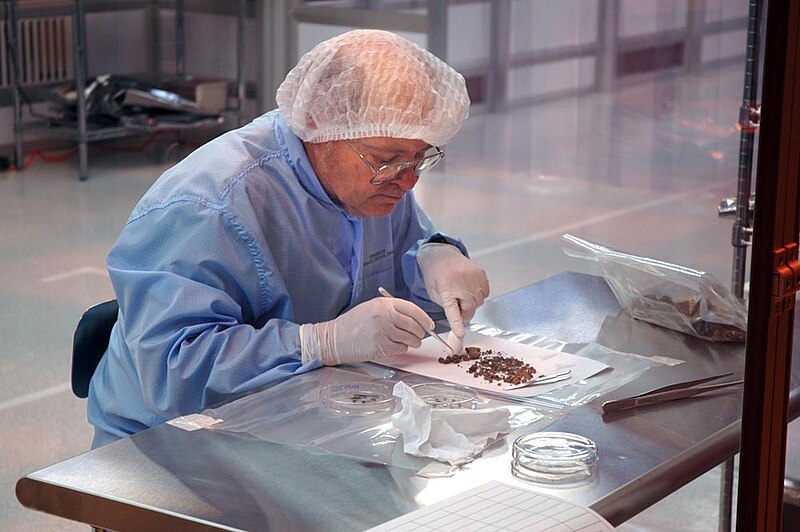
During the return on 08/09/2004, the capsule entered Earth’s atmosphere over the western United States. A planned midair helicopter capture did not occur after the parachute system failed to deploy, and the capsule impacted the Utah Test and Training Range. Despite the hard landing, many collector fragments were recovered and later processed in clean laboratory conditions. Scientists were able to extract usable samples of solar wind ions embedded in the collector materials.
Analysis of the recovered material provided measurements of oxygen, nitrogen, and noble gas isotopes from the solar wind. These results improved understanding of the Sun’s composition and differences between solar and planetary materials. The Genesis mission marked the first return of extraterrestrial material collected beyond lunar orbit and demonstrated the feasibility of collecting and returning samples from deep space environments.
#mooflife
#MomentOfLife
#Nasa
#GenesisMission
#SolarWind
#SampleReturn
#SpaceExploration
Primary Reference
Genesis (spacecraft)

Explore the Life Moments of
 AI Twin