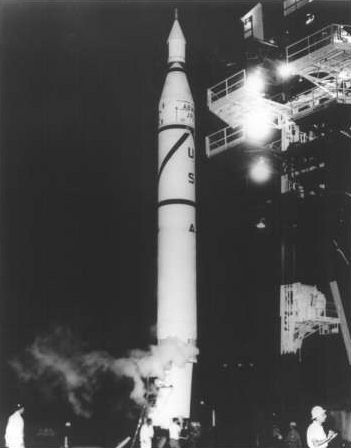
First rocket to enter the exosphere
Cape Canaveral, Florida, United States
Aerospace
Space Exploration
Rocket Technology
3 min read
Updated By: History Editorial Network (HEN)
Published:
Updated:
On 20/09/1956, the United States conducted a Jupiter-C rocket test flight that became the first to reach the exosphere, the outermost layer of Earth’s atmosphere. The launch took place from Cape Canaveral, Florida, using a modified Redstone missile known as Jupiter-C, developed by the U.S. Army Ballistic Missile Agency under the leadership of Wernher von Braun.
During the flight, the rocket reached an altitude of approximately 1,094 kilometers, far beyond the boundaries of the mesosphere and into the exosphere. Although the mission was classified as a suborbital test and did not place a payload into orbit, it demonstrated that a rocket could travel to extreme altitudes approaching spaceflight conditions. The payload reentered the atmosphere after completing its trajectory, confirming the rocket’s performance capabilities.
This test flight provided critical data on high-altitude flight, reentry physics, and rocket staging. Despite achieving the capability to reach orbital velocity, the United States did not immediately attempt to launch a satellite with this rocket due to policy decisions at the time. The technologies demonstrated during this mission later contributed to the successful launch of Explorer 1 in January 1958.
#mooflife
#MomentOfLife
#Jupiter-c
#Exosphere
#RocketTechnology
#SpaceExploration
#Mach18
Primary Reference
Jupiter-C

Explore the Life Moments of
 AI Twin