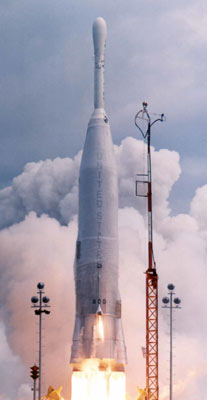
First rocket engine fired in space
Cape Canaveral, Florida, United States
Space Exploration
Aerospace Engineering
Rocket Technology
3 min read
Updated By: History Editorial Network (HEN)
Published:
Updated:
On 25/09/1960, NASA’s Pioneer P-30 spacecraft, also known as Able 5A, achieved a notable technical milestone by becoming the first spacecraft to successfully fire a rocket engine in space. The mission was launched from Cape Canaveral, Florida, as part of NASA’s early Pioneer program, which aimed to explore the Moon and interplanetary space. The spacecraft was mounted atop an Atlas-Able launch vehicle and was intended to enter lunar orbit to collect scientific data about the Moon’s environment and radiation levels.
During its flight, the spacecraft’s onboard propulsion system ignited successfully in space, marking the first confirmed instance of a rocket engine firing beyond Earth’s atmosphere. This demonstration was an important step in validating technologies required for mid-course corrections and orbital insertion in future space missions. However, despite this achievement, the mission did not meet its primary objective. The Atlas booster experienced a failure shortly after launch, leading to the loss of the spacecraft before it could reach its intended trajectory toward the Moon.
Although Pioneer P-30 did not complete its planned lunar mission, the successful in-space engine firing provided engineers with valuable data about propulsion systems operating in the vacuum of space. The Pioneer program continued with subsequent missions, contributing to the gradual advancement of deep-space exploration capabilities during the early years of the Space Race.
#mooflife
#MomentOfLife
#Nasa
#PioneerP-30
#RocketEngine
#SpaceExploration
#PropulsionTechnology
Primary Reference
Pioneer P-30

Explore the Life Moments of
 AI Twin