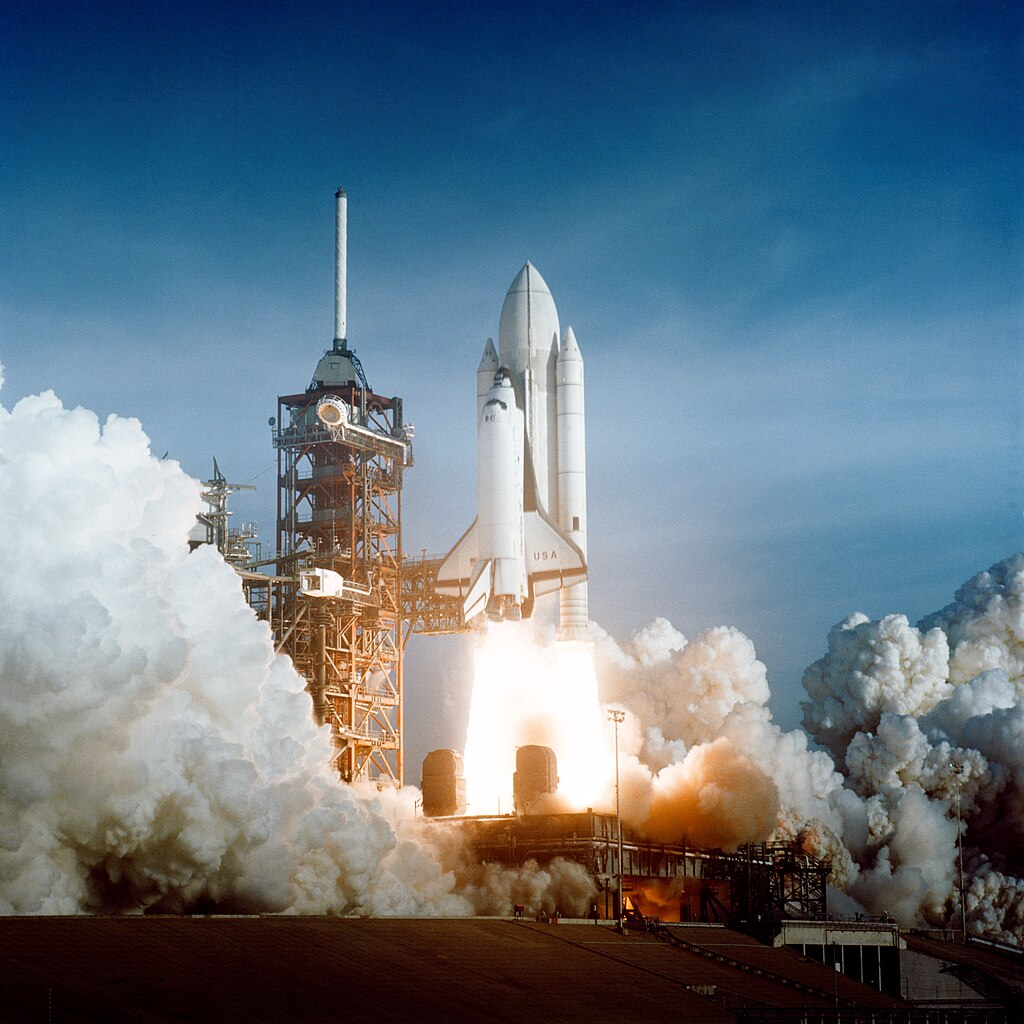
First Reusable Crewed Orbital Spacecraft
Kennedy Space Center, Florida, USA (launch) and Edwards Air Force Base, California, USA (landing), United States
Space Exploration
Aerospace Engineering
NASA Missions
4 min read
Updated By: History Editorial Network (HEN)
Published:
Updated:
On 12/04/1981, NASA launched Space Shuttle Columbia on mission STS-1, marking the first orbital flight of a reusable crewed spacecraft and opening a new chapter in human spaceflight. The launch took place from Kennedy Space Center’s Launch Complex 39A at 7:00:03 a.m. EST, occurring exactly 20 years after Yuri Gagarin’s historic first human spaceflight on 12/04/1961.
Columbia (Orbiter Vehicle-102) carried a two-person crew: Commander John W. Young, who had previously flown in the Gemini and Apollo programs, and Pilot Robert L. Crippen, making his first journey into space. The mission was the first time a crewed spacecraft was launched on its maiden flight, with astronauts onboard from the outset rather than following uncrewed test missions. This approach required extensive ground testing and confidence in the shuttle’s integrated systems.
The STS-1 mission lasted 2 days, 6 hours, 20 minutes, and 53 seconds, during which Columbia completed 36 orbits around Earth. The primary objectives included testing the orbiter’s thermal protection system, flight controls, and overall performance during ascent, orbit, and reentry. The mission concluded on 14/04/1981 with a landing on Runway 23 at Edwards Air Force Base in California, confirming that the shuttle could return safely and be prepared for future missions.
STS-1 demonstrated the feasibility of a partially reusable spacecraft system capable of repeated spaceflights. The success of the mission established the operational foundation for NASA’s Space Shuttle program, which would support satellite deployment, scientific research, and construction missions in orbit for the next three decades.
#mooflife
#MomentOfLife
#SpaceShuttle
#Nasa
#ReusableSpacecraft
#OrbitalMissions
#SpaceExploration
Primary Reference
STS-1

Explore the Life Moments of
 AI Twin