First proper observation of other galaxies
Birr Castle, Ireland
Astronomy
History of Science
Galactic Studies
4 min read
Updated By: History Editorial Network (HEN)
Published:
Updated:
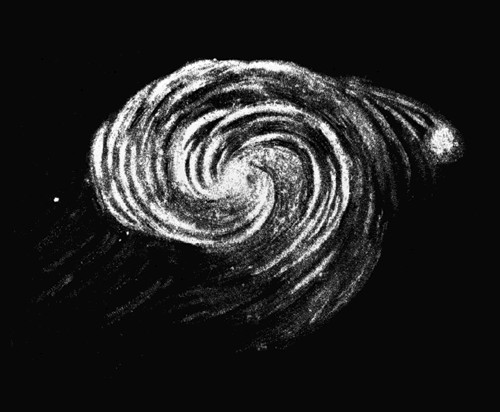
In 1845, astronomers captured the first photograph showing the spiral structure of a nebula, providing a new visual understanding of objects that were not yet recognized as galaxies. The image was taken by William Parsons, the 3rd Earl of Rosse, using his large reflecting telescope known as the “Leviathan of Parsonstown,” located in Birr Castle, Ireland.
Parsons observed and sketched the Whirlpool Nebula (now known as the Whirlpool Galaxy, M51) and identified its distinct spiral form. Around the same period, early photographic attempts began to capture these structures, marking a transition from hand-drawn astronomical records to mechanical image recording. At the time, such objects were commonly referred to as “spiral nebulae,” as their true nature as separate galaxies outside the Milky Way would not be confirmed until the early 20th century.
The identification and recording of spiral structures challenged existing assumptions about the nature of nebulae, which had often been thought of as diffuse clouds of gas within the Milky Way. The ability to visually document these shapes provided astronomers with new data for classification and study, supporting further investigation into the structure and scale of the universe.
This development contributed to the gradual shift in astronomy toward photographic documentation, complementing observational sketches and enabling more consistent analysis of celestial objects over time. It also laid groundwork for later discoveries that would establish galaxies as vast systems of stars beyond our own.
#mooflife
#MomentOfLife
#Astronomy
#Galaxies
#WilliamParsons
#WhirlpoolNebulae
#SpaceExploration
Primary Reference
The Whirlpool Galaxy Was the First Spiral Galaxy to be Observed

Explore the Life Moments of
 AI Twin