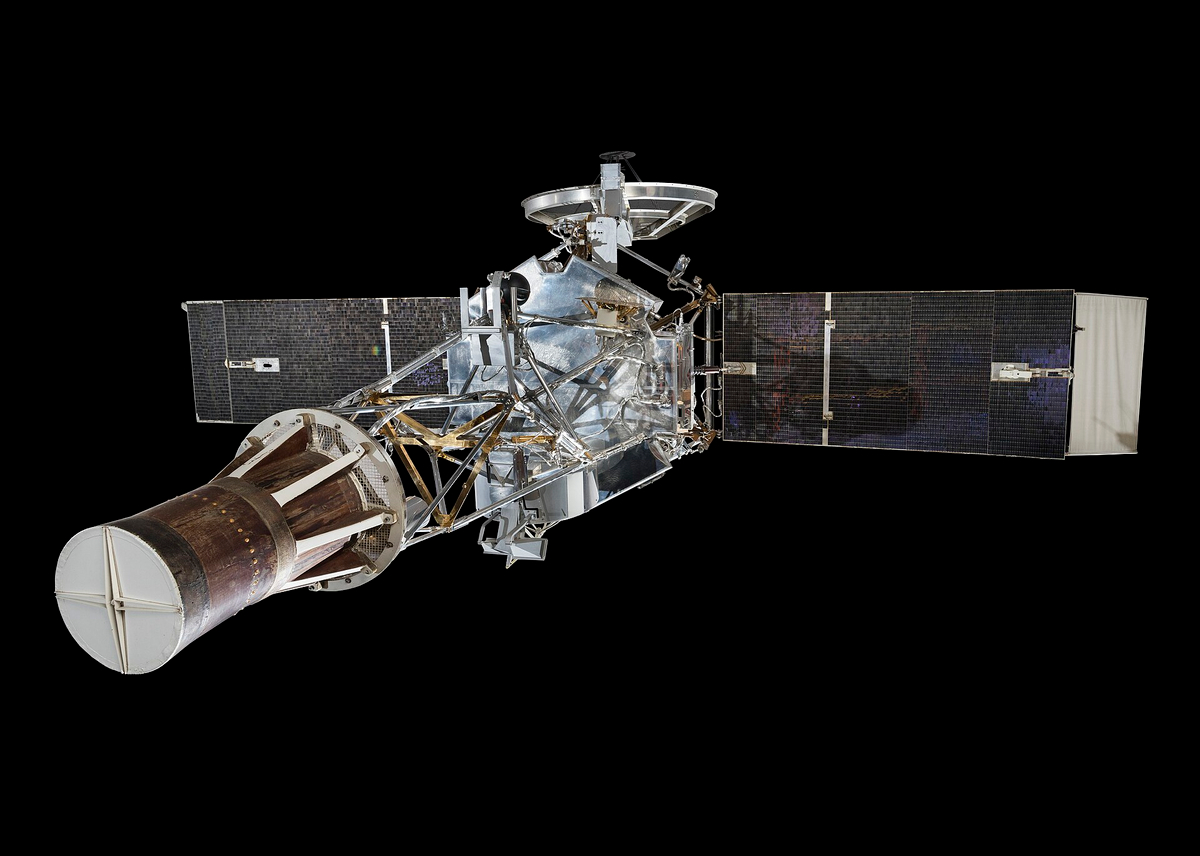
First planetary flyby with data returned
United States
Space Exploration
Planetary Science
Aerospace Engineering
4 min read
Updated By: History Editorial Network (HEN)
Published:
Updated:
On 14/12/1962, NASA’s Mariner 2 spacecraft achieved the first successful flyby of another planet while returning scientific data to Earth, passing within approximately 34,800 kilometers of Venus. Launched on 27/08/1962 from Cape Canaveral, Florida, Mariner 2 was part of NASA’s early interplanetary program aimed at exploring nearby planets and testing deep-space communication capabilities. The mission followed an earlier failed attempt by Mariner 1, making Mariner 2 the first fully successful U.S. mission to another planet.
During its flyby, Mariner 2 carried instruments including microwave and infrared radiometers, a magnetometer, and particle detectors. These instruments measured surface and atmospheric temperatures, confirming that Venus has extremely high surface temperatures, estimated at over 400°C, supporting the theory of a dense atmosphere producing a greenhouse effect. The spacecraft also detected a slow planetary rotation and found no significant magnetic field surrounding Venus.
Mariner 2 transmitted data continuously before, during, and after the encounter, returning valuable measurements about solar wind, cosmic dust, and interplanetary magnetic fields along its trajectory. Communication with the spacecraft continued until 03/01/1963, when contact was lost after it had completed its primary mission objectives.
This mission demonstrated that spacecraft could successfully travel to another planet, conduct scientific observations, and transmit data back to Earth, establishing a model for future interplanetary exploration missions.
#mooflife
#MomentOfLife
#Nasa
#Mariner2
#PlanetaryFlyby
#Venus
#SpaceExploration
Primary Reference
Mariner 2

Explore the Life Moments of
 AI Twin