First operational rover on an asteroid
Asteroid Ryugu, Near-Earth Space
Space Exploration
Astrobiology
Robotics
5 min read
Updated By: History Editorial Network (HEN)
Published:
Updated:
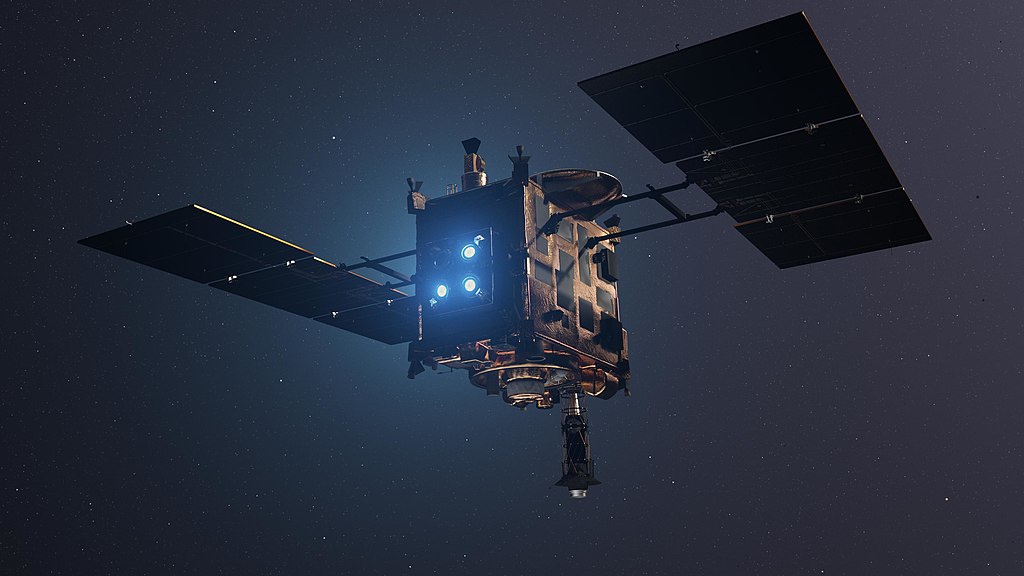
On 21/09/2018, the Japan Aerospace Exploration Agency successfully deployed the first operational rovers on the surface of an asteroid when the Hayabusa2 spacecraft released the MINERVA-II1 rovers onto asteroid Ryugu. The deployment occurred as the spacecraft descended to an altitude of about 55 meters above the asteroid before releasing two small autonomous robots. The twin rovers, named HIBOU and OWL, landed on the surface and began transmitting images and telemetry shortly afterward, marking the first time mobile robots operated on an asteroid. Ryugu is a near Earth carbonaceous asteroid approximately 900 meters in diameter.
Because Ryugu’s gravity is extremely weak, conventional wheeled movement would not function effectively. The MINERVA-II1 rovers used an internal rotating mass to generate hopping motion, allowing them to move across the surface in ballistic arcs. Some hops reached heights of up to about 15 meters and lasted several minutes due to the low gravity environment. During their movements, the rovers captured images, measured surface temperatures, and recorded the asteroid’s terrain. These observations provided the first photographs taken from the surface of an asteroid by mobile robotic explorers.
HIBOU operated for about 36 Earth days, continuing to transmit images and data while performing multiple hops. OWL functioned for approximately three Earth days before its battery was depleted. The rovers observed a rocky surface covered with boulders and coarse material, providing context for later operations by the Hayabusa2 spacecraft. Their successful deployment demonstrated the feasibility of mobile exploration on very small bodies where gravity is insufficient for traditional rover mobility systems.
The rover deployment formed part of the broader Hayabusa2 mission, which aimed to study primitive material from the early solar system. The spacecraft later collected both surface and subsurface samples from Ryugu and returned them to Earth in a capsule that landed in Australia on 06/12/2020. Data from the MINERVA-II1 rovers contributed to selecting sampling locations and understanding surface conditions prior to sample collection.
#mooflife
#MomentOfLife
#Hayabusa2
#AsteroidExploration
#Jaxa
#MascotRover
#SpaceMissions
Primary Reference
[HAYABUSA2 PROJECT] Naming our MINERVA-II1 rovers

Explore the Life Moments of
 AI Twin