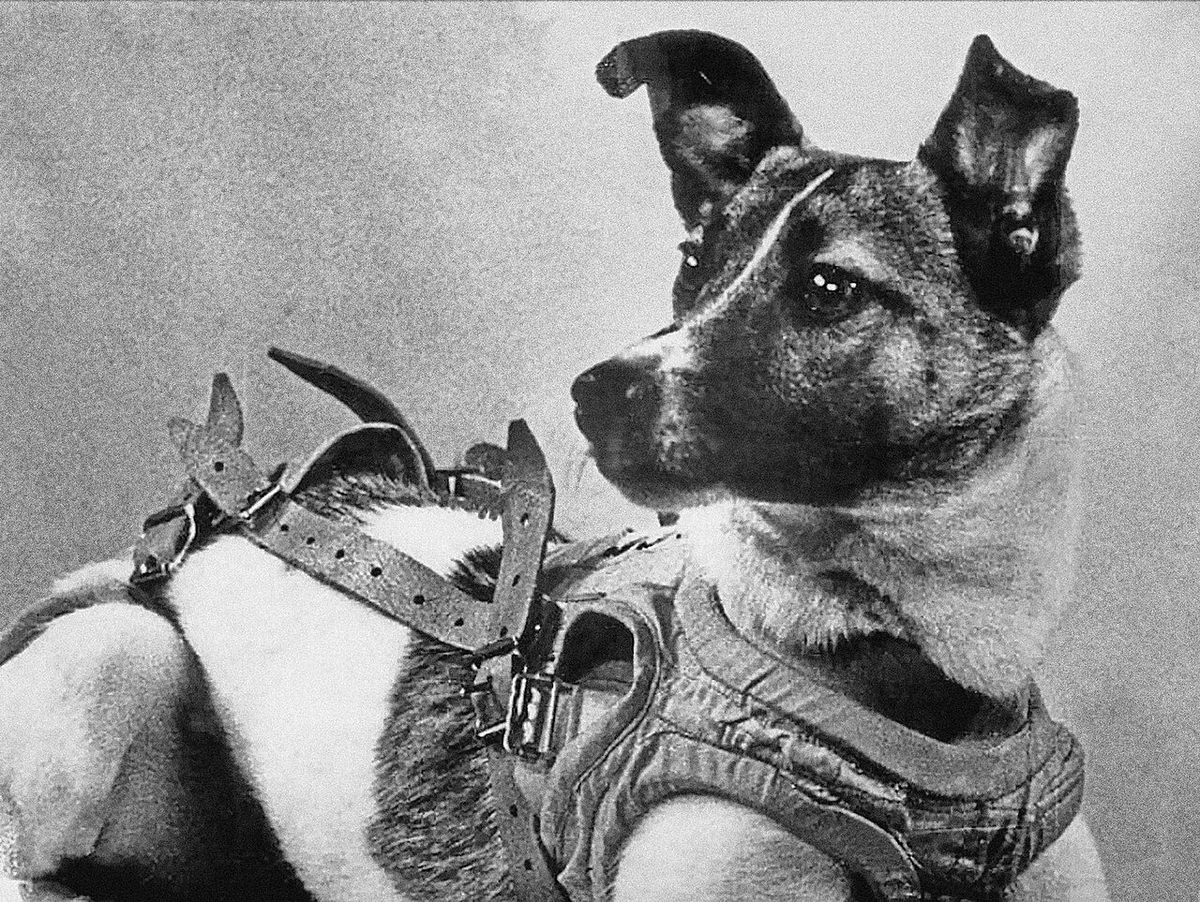
First Mammal in Orbit: Laika the Dog
Baikonur Cosmodrome, Soviet Union, Russian Federation
Space
Animals
3 min read
Updated By: History Editorial Network (HEN)
Published:
Updated:
On 03/11/1957, the Soviet Union launched Sputnik 2 from the Baikonur Cosmodrome, carrying Laika, a stray dog from Moscow, who became the first mammal to orbit Earth. The mission followed the success of Sputnik 1 and was designed to study the effects of spaceflight on living organisms, particularly the challenges of weightlessness and confinement during orbital travel.
Sputnik 2 was a one-way mission, as the spacecraft was not equipped with a reentry system. Laika was placed inside a pressurized cabin with a harness and life-support systems that provided oxygen, food, and temperature control. Sensors monitored her heart rate, respiration, and blood pressure. Data transmitted during the flight showed that Laika adapted to weightlessness, although her heart rate initially increased significantly during launch. The spacecraft completed multiple orbits around Earth, providing the first direct biological data from an animal in orbit.
It was later confirmed that Laika did not survive long after launch due to overheating caused by thermal control issues within the spacecraft. Despite this, the mission provided critical information about the physiological effects of space travel on mammals, contributing to the development of life-support systems for future human spaceflight.
#mooflife
#MomentOfLife
#Laika
#FirstMammalInOrbit
#Sputnik2
#SpaceExploration
#Ussr
Primary Reference
Laika

Explore the Life Moments of
 AI Twin