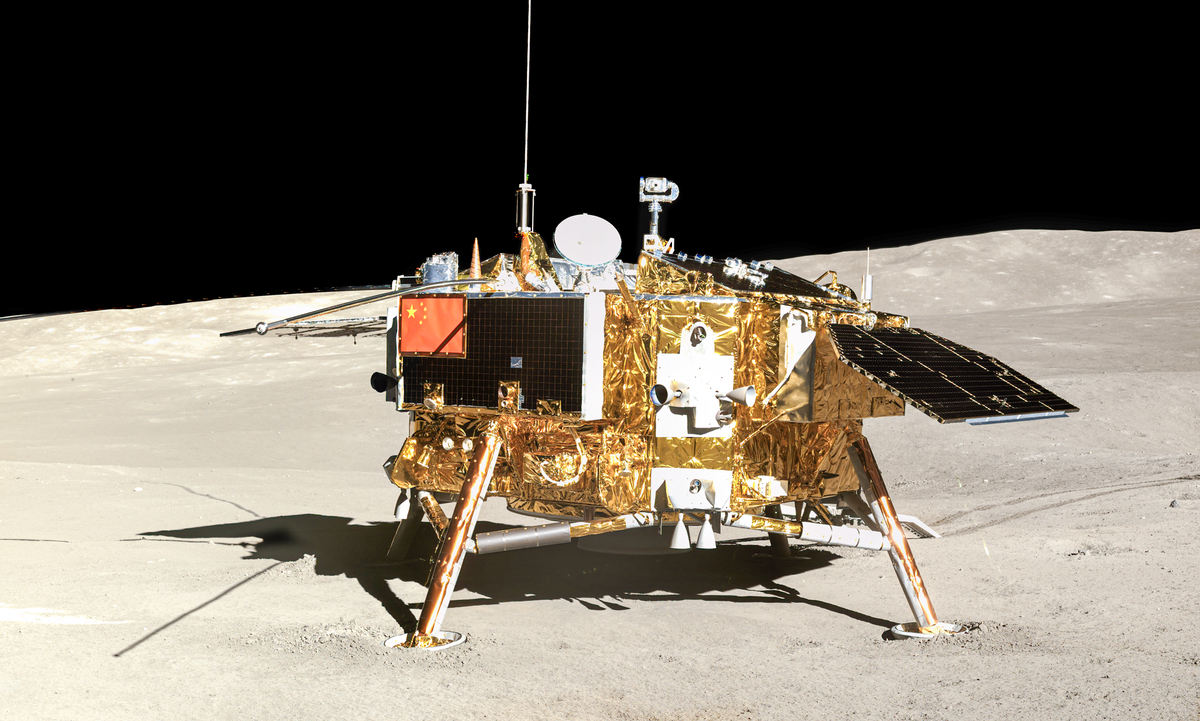
First lunar rover traversing the far side of the Moon
Von Kármán Crater, South Pole-Aitken Basin, Moon
Space Exploration
Lunar Missions
Robotics
5 min read
Updated By: History Editorial Network (HEN)
Published:
Updated:
On 03/01/2019, China’s Yutu-2 rover became the first robotic vehicle to traverse the far side of the Moon following the successful Chang’e-4 landing in the Von Kármán crater within the South Pole-Aitken Basin. The Chang’e-4 lander touched down at approximately 02:26 UTC, marking the first soft landing ever achieved on the lunar far side. About 12 hours later, at 14:22 UTC, the Yutu-2 rover deployed from the lander using a ramp and began surface operations. The landing site lies inside one of the largest and oldest impact basins in the Solar System, offering access to deep lunar material not easily observed on the near side.
Because the Moon’s far side never faces Earth, the mission relied on the Queqiao relay satellite to maintain communications. Queqiao, launched on 21/05/2018, was placed in a halo orbit around the Earth Moon L2 point, allowing it to relay commands and telemetry between mission control and the lander and rover. This relay architecture enabled continuous data transmission and remote operation despite the absence of direct line of sight. The communications system was essential for navigation, scientific operations, and image transmission from the far side surface.
Yutu-2 carried a suite of instruments including ground penetrating radar to study subsurface layering and a visible and near infrared spectrometer to analyze mineral composition. These instruments were intended to investigate regolith thickness, buried structures, and potential mantle derived materials exposed by the South Pole-Aitken impact. The rover also used panoramic cameras to document terrain and assist in route planning across the crater floor. Early observations revealed layered subsurface structures and helped characterize local geology in the previously unexplored region.
Originally designed for a three month operational lifetime, Yutu-2 continued functioning well beyond expectations. In late 2019, it surpassed the operational duration of the Soviet Lunokhod 1 rover, becoming the longest lived lunar rover. The rover continued periodic operations through multiple lunar days, contributing ongoing measurements of the far side environment and surface composition.
#mooflife
#MomentOfLife
#Chang'e4
#Yutu-2
#LunarRover
#FarSideOfTheMoon
#Cnsa
Primary Reference
Chang'e 4

Explore the Life Moments of
 AI Twin