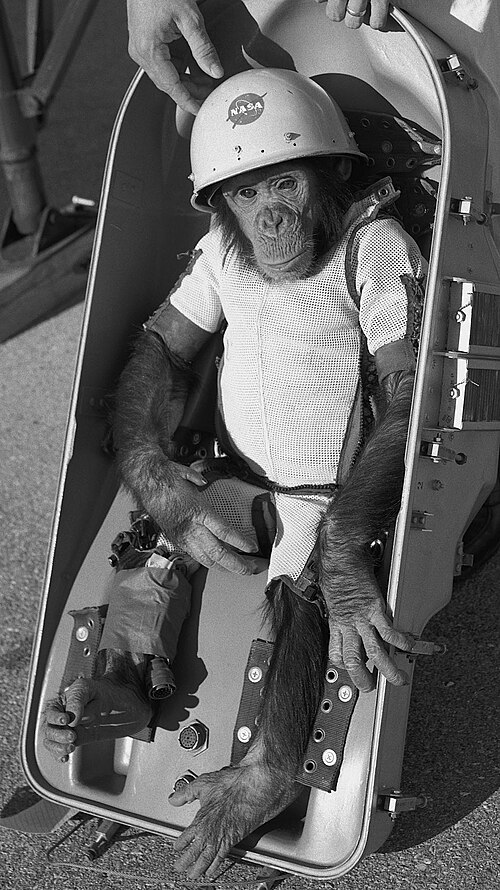
First Hominidae in Space with Chimpanzee Ham
Cape Canaveral, Florida, United States
Space Exploration
NASA
3 min read
Updated By: History Editorial Network (HEN)
Published:
Updated:
On 31/01/1961, a chimpanzee named Ham became the first member of the Hominidae family to travel into space, flying aboard a Mercury-Redstone 2 mission launched by NASA from Cape Canaveral, Florida. The suborbital flight was part of Project Mercury, designed to test spacecraft systems and evaluate the ability of a living subject to perform tasks under spaceflight conditions ahead of the first human missions.
Ham was secured inside a specially designed capsule equipped with life-support systems and monitoring instruments to track his vital signs and responses. During the flight, he was trained to perform simple tasks, such as pushing levers in response to light cues, allowing scientists to assess cognitive and motor performance in weightlessness and under acceleration. The spacecraft reached an altitude of approximately 253 kilometers and traveled downrange before reentering Earth’s atmosphere.
Although the capsule experienced a higher-than-planned velocity and a longer flight duration, Ham survived the mission and was recovered safely in the Atlantic Ocean. Data from the flight showed that he was able to perform tasks during periods of weightlessness, providing confidence that humans could function in space. The mission directly supported the subsequent flight of Alan Shepard, the first American astronaut in space, later that year on 05/05/1961.
#mooflife
#MomentOfLife
#HominidaeInSpace
#ChimpanzeeHam
#NasaM-r2
#SpaceExploration
#AnimalSpaceflight
Primary Reference
Ham (chimpanzee)

Explore the Life Moments of
 AI Twin