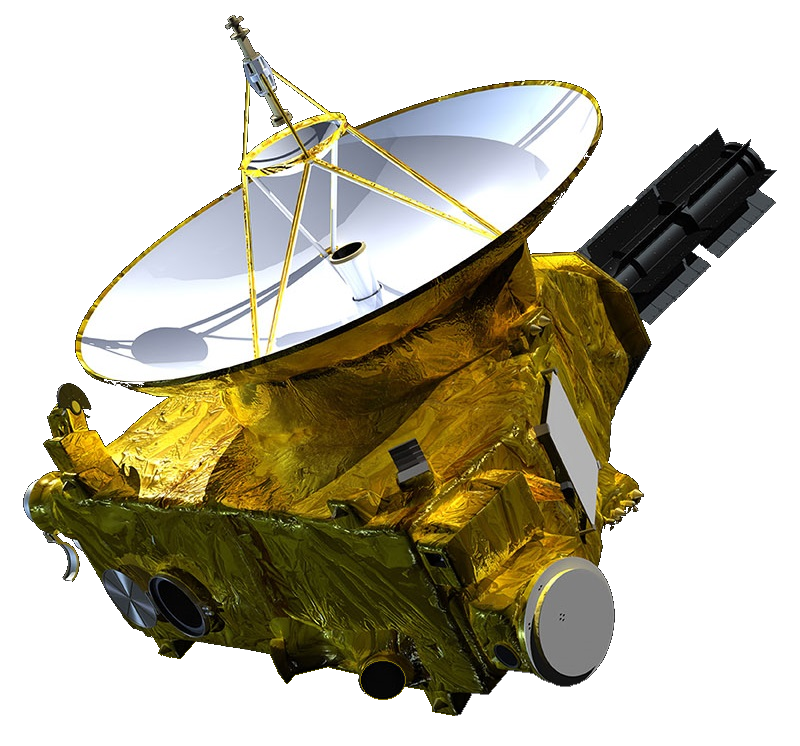
First flyby of a classical Kuiper belt object
(486958) Arrokoth, Kuiper Belt, approximately 6.47 billion km from the Sun
Space Exploration
Astronomy
Planetary Science
5 min read
Updated By: History Editorial Network (HEN)
Published:
Updated:
On 01/01/2019, NASA’s New Horizons spacecraft performed the first close up flyby of the small Kuiper Belt object (486958) Arrokoth, marking the most distant exploration of a planetary body ever conducted. The encounter occurred about 6.47 billion kilometers from the Sun, more than 1.6 billion kilometers beyond Pluto, which New Horizons had visited in July 2015. The spacecraft passed within approximately 3,500 kilometers of Arrokoth while traveling at about 14 kilometers per second, collecting high resolution images and scientific measurements during the brief flyby. The object, initially nicknamed Ultima Thule, was later officially named Arrokoth, meaning “sky” in the Powhatan Algonquian language.
Images returned after the encounter revealed that Arrokoth is a contact binary composed of two flattened lobes joined by a narrow neck. The larger lobe was named Wenu and the smaller Weeyo. The object measures roughly 36 kilometers across and has a distinctive snowman like appearance. The smooth junction between the two lobes indicated that they merged gently at low speed early in the solar system’s history. This morphology provided direct evidence supporting models in which small bodies formed through gradual accumulation of material within collapsing pebble clouds rather than through high speed collisions.
Spectral data showed that Arrokoth has a reddish surface color caused by complex organic molecules known as tholins. Observations also indicated the presence of methanol ice along with evidence for water ice and other simple compounds such as hydrogen cyanide. The surface appeared relatively smooth with few large craters, suggesting the object has remained largely unchanged since its formation about 4.5 billion years ago. As a member of the cold classical Kuiper Belt population, Arrokoth follows a nearly circular orbit and has experienced minimal gravitational disturbance, making it a preserved remnant of early solar system formation.
The New Horizons flyby provided the first close examination of a small primordial Kuiper Belt object and extended exploration far beyond Pluto. Data from the encounter helped refine theories of planetesimal formation and offered insight into the composition and structure of early building blocks that eventually formed planets. The spacecraft continued deeper into the Kuiper Belt after the flyby, transmitting stored observations back to Earth over many months due to the extreme distance.
#mooflife
#MomentOfLife
#KuiperBelt
#NewHorizons
#Nasa
#Arrokoth
#SpaceExploration
Primary Reference
New Horizons

Explore the Life Moments of
 AI Twin