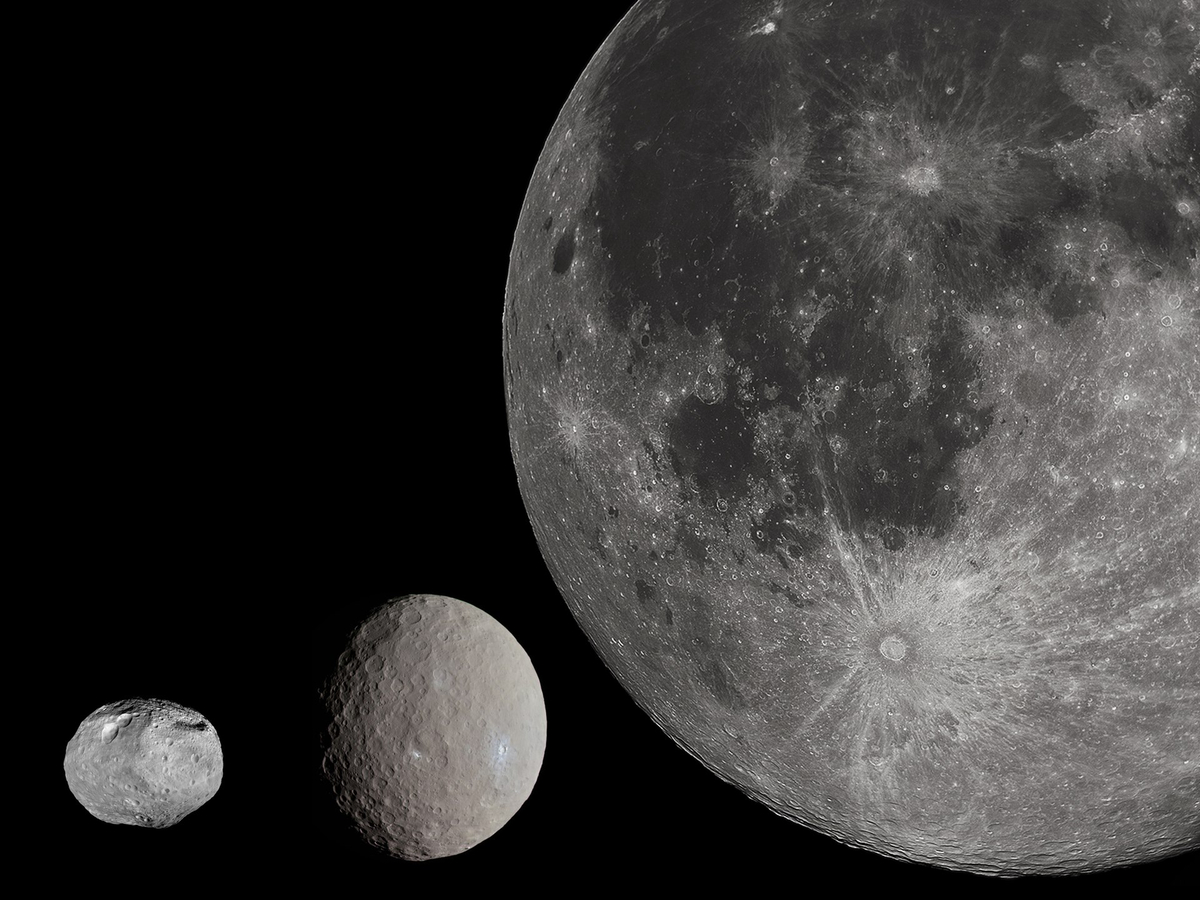
First flyby and orbit of a dwarf planet
Orbit of Ceres, Asteroid Belt
Space Exploration
Astronomy
Planetary Science
4 min read
Updated By: History Editorial Network (HEN)
Published:
Updated:
On 06/03/2015, NASA’s Dawn spacecraft became the first mission to enter orbit around a dwarf planet when it was captured by the gravity of Ceres. The orbital insertion occurred at approximately 4:39 a.m. PST after a journey of about 7.5 years and roughly 3.1 billion miles since launch in September 2007. Because of the distance from Earth, confirmation of the capture was received later via telemetry from NASA’s Deep Space Network. The maneuver did not require a traditional engine burn, as Dawn used its ion propulsion system to gradually match velocity with Ceres and allow gravitational capture.
This milestone also made Dawn the first spacecraft to orbit two separate extraterrestrial bodies. Prior to reaching Ceres, the spacecraft spent 14 months studying the asteroid Vesta between July 2011 and September 2012. After departing Vesta, Dawn used its ion propulsion system to spiral outward through the asteroid belt and rendezvous with Ceres. The mission was managed by NASA’s Jet Propulsion Laboratory as part of the Discovery Program, with the ion propulsion system enabling extended operations and multiple orbital targets.
Once in orbit, Dawn began mapping Ceres and studying its surface composition and geology. Early images revealed bright reflective spots inside Occator Crater, later identified as deposits of sodium carbonate and other salts. The spacecraft also observed Ahuna Mons, a solitary pyramid shaped mountain rising about 4 kilometers above the surrounding terrain. These findings suggested that Ceres experienced cryovolcanic activity and retains subsurface briny material. Dawn continued observations from progressively lower orbits, collecting data on gravity, mineral composition, and internal structure.
#mooflife
#MomentOfLife
#DawnSpacecraft
#Ceres
#DwarfPlanet
#Nasa
#SpaceExploration
Primary Reference
Dawn (spacecraft)

Explore the Life Moments of
 AI Twin