First extended orbital exploration of Venus
Orbit around Venus
Space Exploration
Planetary Science
Aerospace Engineering
4 min read
Updated By: History Editorial Network (HEN)
Published:
Updated:
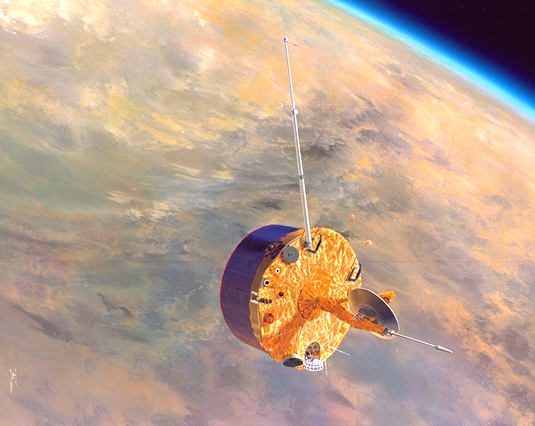
On 04/12/1978, NASA’s Pioneer Venus Orbiter, also known as Pioneer 12, successfully entered orbit around Venus, initiating the first long-duration orbital study of the planet. The spacecraft had been launched earlier that year on 20/05/1978 and was designed to conduct extended observations of Venus’s atmosphere, surface, and surrounding space environment.
After orbital insertion, the Pioneer Venus Orbiter began a mission that would last nearly 14 years, far exceeding typical mission lifespans of the time. While earlier missions such as the Soviet Venera 9 had achieved orbit around Venus, Pioneer 12 was specifically built for sustained observation, enabling continuous data collection over an extended period. Its instruments studied Venus’s dense cloud layers, atmospheric composition, and temperature structure, as well as interactions between the solar wind and the planet’s upper atmosphere.
The orbiter contributed to mapping the Venusian surface using radar, helping to reveal large-scale features hidden beneath thick clouds. It also provided data on the planet’s ionosphere and magnetosphere, offering insights into how Venus interacts with solar radiation despite lacking a strong intrinsic magnetic field. Over time, the spacecraft observed atmospheric changes and contributed to a better understanding of Venus’s climate dynamics.
The Pioneer Venus Orbiter remained operational until October 1992, when it eventually entered the planet’s atmosphere and disintegrated. Its long service made it one of NASA’s most durable planetary missions and a key source of data on Venus for more than a decade.
#mooflife
#MomentOfLife
#PioneerVenusOrbiter
#VenusExploration
#NasaMissions
#PlanetaryScience
#OrbitalExploration
Primary Reference
Pioneer Venus project

Explore the Life Moments of
 AI Twin