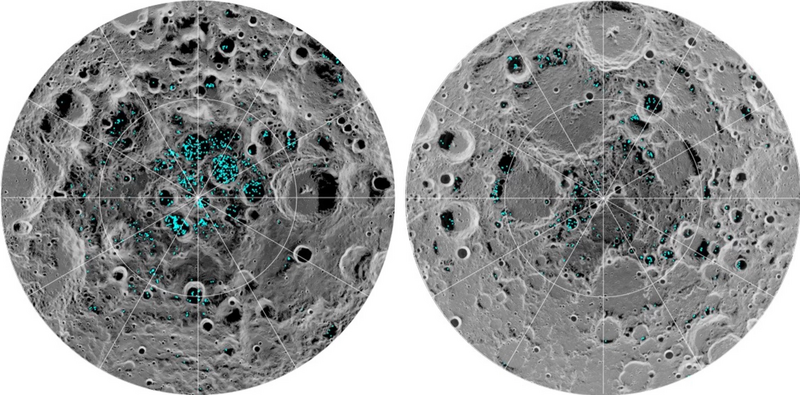
First discovery of lunar water in ice form
Lunar Orbit, Moon
Space Exploration
Astrophysics
Planetary Science
4 min read
Updated By: History Editorial Network (HEN)
Published:
Updated:
On 08/11/2008, the Indian Space Research Organisation successfully inserted the Chandrayaan-1 spacecraft into lunar orbit, marking India’s first mission to the Moon. The lunar orbit insertion maneuver slowed the spacecraft using its main engine, allowing the Moon’s gravity to capture it after a journey that began with launch on 22/10/2008 from the Satish Dhawan Space Centre. Following capture, Chandrayaan-1 entered an elliptical orbit that was later refined into a near circular polar orbit at about 100 kilometers above the lunar surface, enabling global mapping and scientific observations.
Chandrayaan-1 carried 11 scientific instruments from India, NASA, ESA, and other partners. Among them was NASA’s Moon Mineralogy Mapper, designed to analyze reflected sunlight across infrared wavelengths to identify minerals and volatiles. The spacecraft also deployed the Moon Impact Probe, which struck the lunar surface on 14/11/2008 near the south polar region, collecting atmospheric and surface data during descent. These observations contributed to detecting signatures of hydroxyl and water molecules in lunar soil.
Data returned from Chandrayaan-1 later provided the first definitive evidence of water in molecular and ice form on the Moon. Spectral measurements revealed widespread hydroxyl and water signatures across the lunar surface, with stronger concentrations near the poles. Additional radar and spectral analyses supported the presence of water ice in permanently shadowed craters. The findings reshaped understanding of the Moon’s composition and influenced planning for future lunar exploration missions focused on polar regions.
#mooflife
#MomentOfLife
#LunarWater
#Chandrayaan-1
#Isro
#MoonExploration
#SpaceDiscovery
Primary Reference
Lunar water

Explore the Life Moments of
 AI Twin