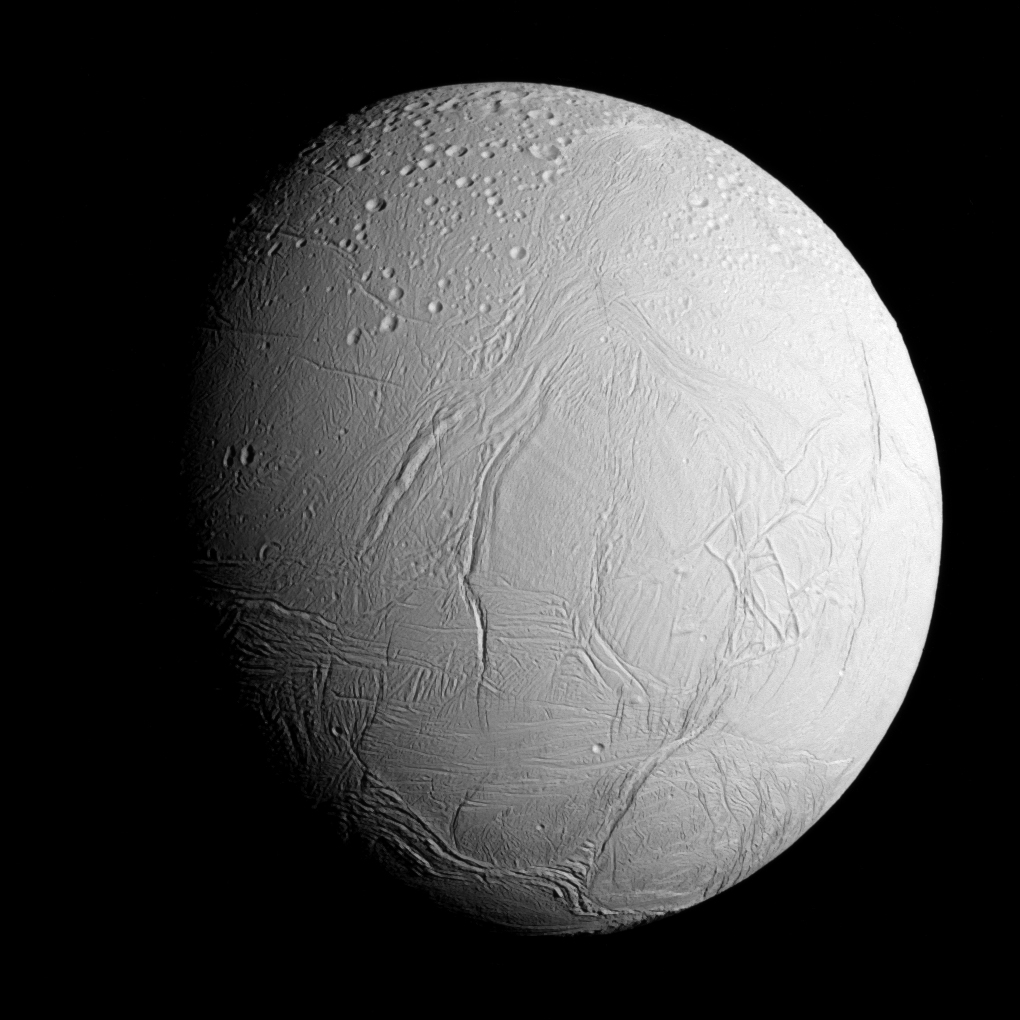
First Confirmed Cryovolcano Discovered on Enceladus
Enceladus, Saturn System
Science
Space Exploration
Astronomy
4 min read
Updated By: History Editorial Network (HEN)
Published:
Updated:
In 2005, NASA’s Cassini spacecraft discovered definitive evidence of active cryovolcanism on Saturn’s moon Enceladus while conducting close flybys of the small icy world. During encounters in February, March, and July 2005, Cassini instruments detected jets of water vapor, ice particles, and organic compounds erupting from fractures near the moon’s south pole. These fissures, later nicknamed the tiger stripes, appeared warmer than surrounding terrain and were aligned with the source of the observed plumes extending into space.
Cassini’s imaging cameras first revealed a geologically young south polar region with relatively few impact craters. Subsequent measurements from the spacecraft’s magnetometer, dust analyzer, and infrared spectrometer confirmed the presence of active jets. The plumes originated from long parallel fractures, including features later named Baghdad Sulcus, Damascus Sulcus, Cairo Sulcus, and Alexandria Sulcus. Temperature readings showed localized hotspots significantly warmer than the surrounding icy surface, supporting the interpretation of subsurface activity.
The discovery indicated that Enceladus possesses an internal heat source capable of maintaining liquid water beneath the surface. Material from the plumes was found to feed Saturn’s E ring, linking Enceladus directly to ring formation processes. Later flybys confirmed that the ejected particles included water ice grains, salts, and organic molecules, suggesting a subsurface ocean interacting with rocky material. These findings established Enceladus as one of the most active bodies in the outer solar system.
Cassini’s 2005 observations marked the first confirmed detection of ongoing cryovolcanism beyond Earth, with water rich plumes erupting from an icy moon. The discovery transformed Enceladus into a major target for astrobiology and future exploration focused on subsurface oceans.
#mooflife
#MomentOfLife
#Enceladus
#Cryovolcano
#Cassinihuygens
#PlanetaryScience
#SaturnMoons
Primary Reference
Enceladus

Explore the Life Moments of
 AI Twin