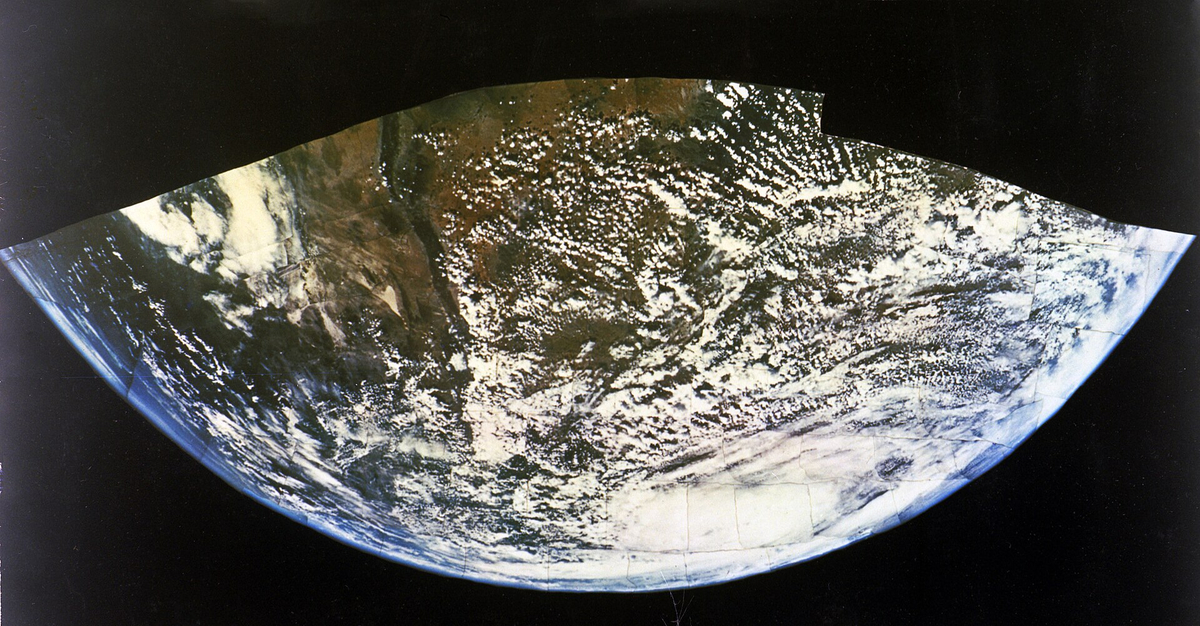
First Color Photo of Earth from Space
White Sands Proving Ground, New Mexico, United States
Space Photography
Earth Observation
Astronomy Milestones
3 min read
Updated By: History Editorial Network (HEN)
Published:
Updated:
On 05/10/1954, one of the earliest color photographs of Earth from space was captured during a high-altitude rocket experiment conducted by the United States. The mission took place at White Sands Proving Ground in New Mexico, where modified V-2 rockets were used in post-war scientific research to study the upper atmosphere and test imaging technologies. These suborbital flights carried cameras equipped with color film beyond most of Earth’s atmosphere.
During the flight, the rocket ascended to a high altitude, allowing its onboard camera to capture images of Earth’s curvature against the darkness of space. The camera system recorded photographs on color film, which were preserved during descent and later recovered after the payload returned to Earth by parachute. These images provided a new visual perspective compared to earlier black-and-white photographs taken from similar missions in the late 1940s.
Although limited in clarity and coverage compared to later satellite imagery, these early color photographs demonstrated the feasibility of capturing Earth in color from space. The data and experience gained from such experiments contributed to the development of advanced imaging systems used in satellites and crewed missions, enabling continuous observation of Earth’s atmosphere and surface.
#mooflife
#MomentOfLife
#ColorPhotoEarth
#SpacePhotography
#BergFilmI
#EnvironmentalAwareness
#EarthFromSpace
Primary Reference
First Color Photo of Earth from Space Unearthed!

Explore the Life Moments of
 AI Twin