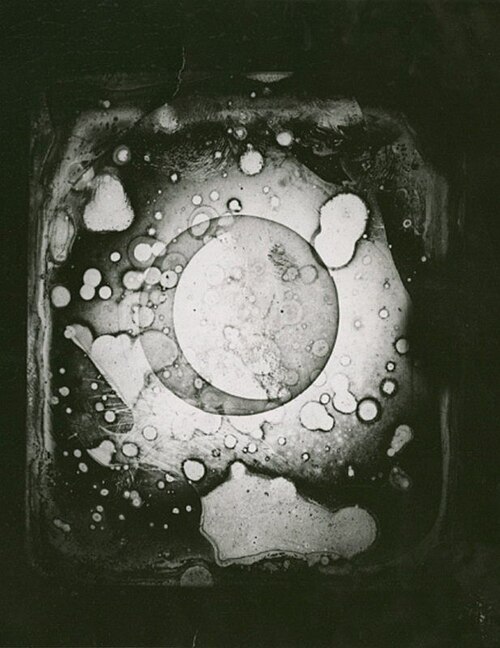
First clear telescopic photograph of the Moon
New York University, New York, United States
Astronomy
Photography
Space Exploration
4 min read
Updated By: History Editorial Network (HEN)
Published:
Updated:
In 1840, American scientist John William Draper produced the first detailed telescopic photograph of the Moon, marking an early milestone in the development of astrophotography. Draper, a professor at New York University, used the daguerreotype process, an early photographic technique that involved exposing a silver-coated copper plate to light and then developing the image with chemical treatment.
To achieve this result, Draper combined a telescope with a camera apparatus, allowing him to capture the Moon’s surface in greater detail than previously possible through direct observation alone. The resulting image showed visible features such as craters and surface variations, demonstrating that celestial objects could be permanently recorded using photographic methods rather than relying solely on hand-drawn sketches.
This achievement represented one of the first successful attempts to apply photography to astronomy. At the time, long exposure times and technical limitations made such work difficult, but Draper’s experiment showed that it was feasible to document astronomical objects with precision. His work laid the groundwork for later advancements in astrophotography, including more refined lunar imaging and the eventual capture of stars, planets, and deep-sky objects.
Draper’s efforts contributed to a shift in astronomical practice, enabling observations to be recorded, shared, and analyzed with greater accuracy. Over time, photographic techniques would become central to astronomy, supporting discoveries ranging from planetary studies to the mapping of distant galaxies.
#mooflife
#MomentOfLife
#Astronomy
#Photography
#LunarExploration
#JohnWilliamDraper
#Astrophotography
Primary Reference
The John Draper Lunar Daguerreotype

Explore the Life Moments of
 AI Twin