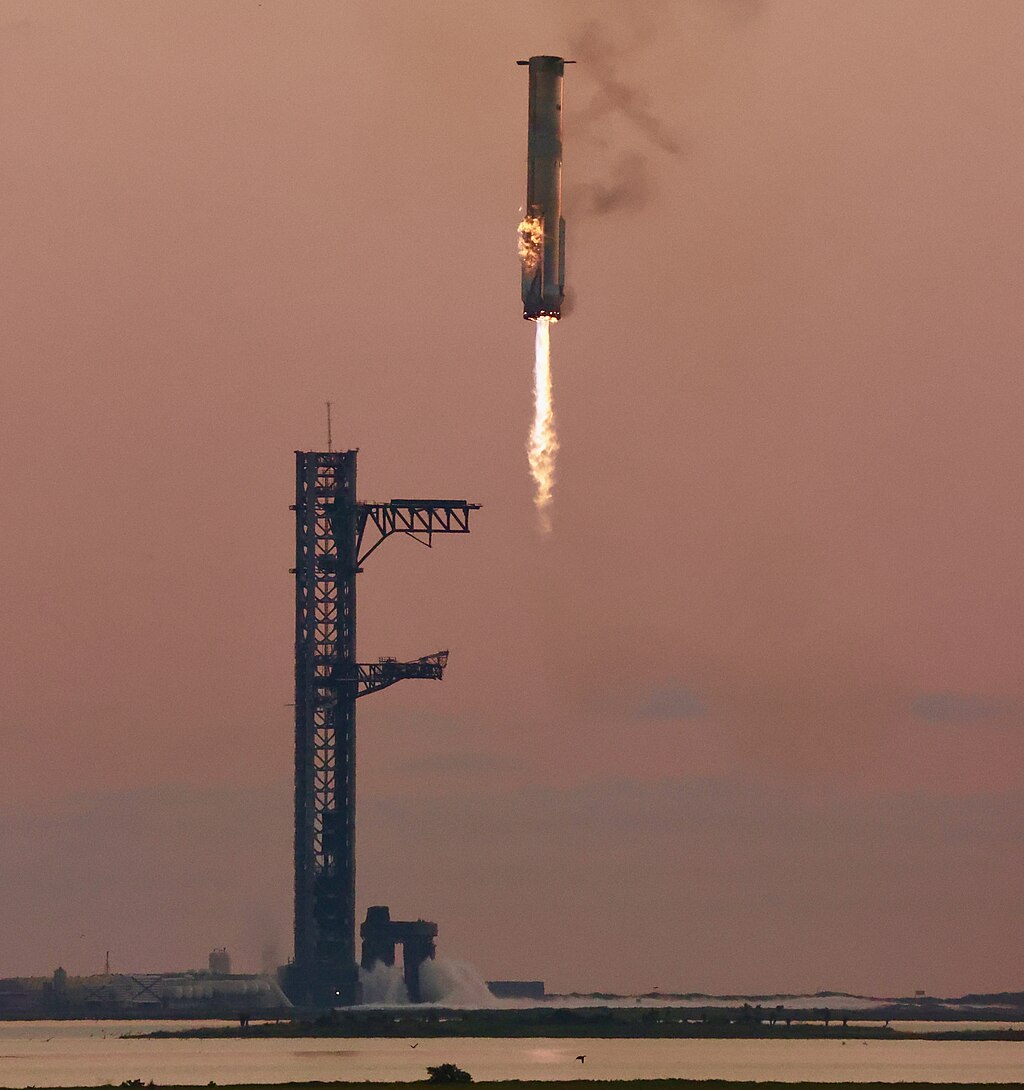
First catch of a rocket booster
Starbase, Boca Chica, Texas, United States
Aerospace
Space Exploration
Rocket Technology
4 min read
Updated By: History Editorial Network (HEN)
Published:
Updated:
On 13/10/2024, SpaceX successfully caught a returning Super Heavy booster mid-air using the mechanical arms of its launch tower during Starship Flight Test 5 at Starbase in Boca Chica, Texas. The launch occurred at 7:25 a.m. local time (CDT), sending the Starship upper stage into a suborbital trajectory while the Super Heavy booster performed a boostback maneuver toward the launch site. As the booster descended, it slowed to a near hover and aligned with the tower’s “Mechazilla” arms, which closed around the vehicle to secure it, marking the first successful mid-air capture of a rocket booster using this method.
After stage separation, the Starship upper stage continued into space and traveled on a trajectory toward the Indian Ocean. The spacecraft reentered Earth’s atmosphere and performed a controlled splashdown roughly an hour after liftoff near western Australia. The test demonstrated both the booster return to launch site capture and a full suborbital flight of the upper stage, with improved reentry performance compared with earlier tests. The booster returned approximately seven minutes after launch, while the spacecraft completed its longer downrange flight before splashdown.
NASA Administrator Bill Nelson publicly congratulated SpaceX following the flight, praising the successful booster catch and the fifth Starship test. Astronaut Chris Hadfield and other aerospace leaders also commented on the achievement, highlighting the engineering milestone. The capture technique is designed to support rapid reuse of the Super Heavy booster and is part of SpaceX’s approach for future missions involving cargo and crew transport beyond Earth orbit.
#mooflife
#MomentOfLife
#Spacex
#RocketBooster
#ReusableLaunchVehicles
#AerospaceInnovation
#SpaceExploration
Primary Reference
Starship flight test 5

Explore the Life Moments of
 AI Twin