Deep Survey of Earth's Magnetic Tail
Sun–Earth L1 region to Earth’s magnetotail, near-Earth space
Space Exploration
Earth Science
Astrophysics
4 min read
Updated By: History Editorial Network (HEN)
Published:
Updated:
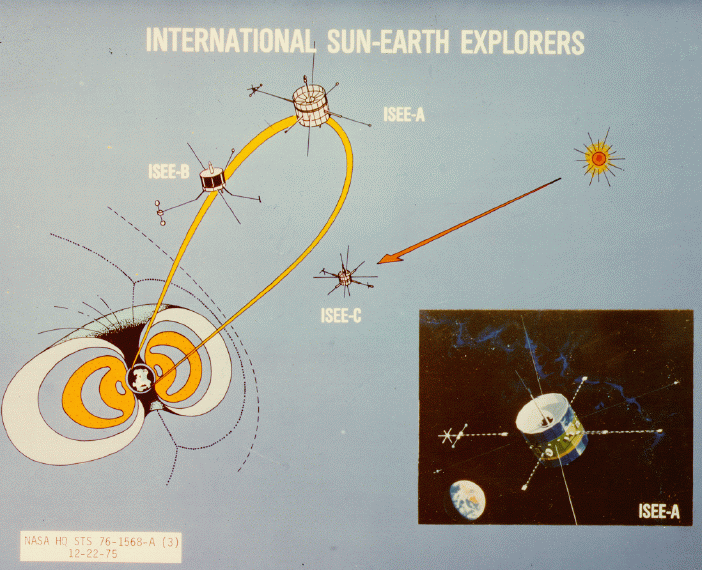
On 10/06/1982, NASA’s International Sun-Earth Explorer-3 (ISEE-3) spacecraft initiated a maneuver that marked the beginning of the first systematic exploration of Earth’s magnetotail, the elongated extension of the planet’s magnetic field stretching away from the Sun. Originally launched on 12/08/1978, ISEE-3 had spent several years positioned at the Sun–Earth L1 Lagrange point, studying the solar wind before being reassigned to a new mission phase.
The maneuver on 10 June 1982 used onboard thrusters to move the spacecraft out of its stable halo orbit around L1 and redirect it toward the magnetotail. This transition required precise navigation and was followed by a series of complex trajectory adjustments, including multiple lunar gravity assists. These maneuvers allowed ISEE-3 to repeatedly pass through different regions of the magnetotail, extending hundreds of thousands of kilometers beyond Earth’s nightside.
During this survey, ISEE-3 collected the first in-situ measurements of the distant magnetotail and identified dynamic plasma activity within it. One of the key observations was the detection of plasmoids, large structures of electrically charged gas that form when magnetic field lines reconnect and release energy. These plasmoids were observed being ejected down the magnetotail into space, providing direct evidence of large-scale magnetic reconnection processes occurring in Earth’s magnetosphere.
The findings from ISEE-3 contributed to a better understanding of how Earth’s magnetic field interacts with the solar wind and how energy is transferred and released in near-Earth space. After completing this phase, the spacecraft was later redirected again and became known as the International Cometary Explorer (ICE), eventually encountering Comet Giacobini–Zinner in 1985.
#mooflife
#MomentOfLife
#Earth'sMagneticTail
#NasaIsee-3
#SpaceExploration
#Magnetosphere
#SpaceWeather
Primary Reference
International Cometary Explorer

Explore the Life Moments of
 AI Twin