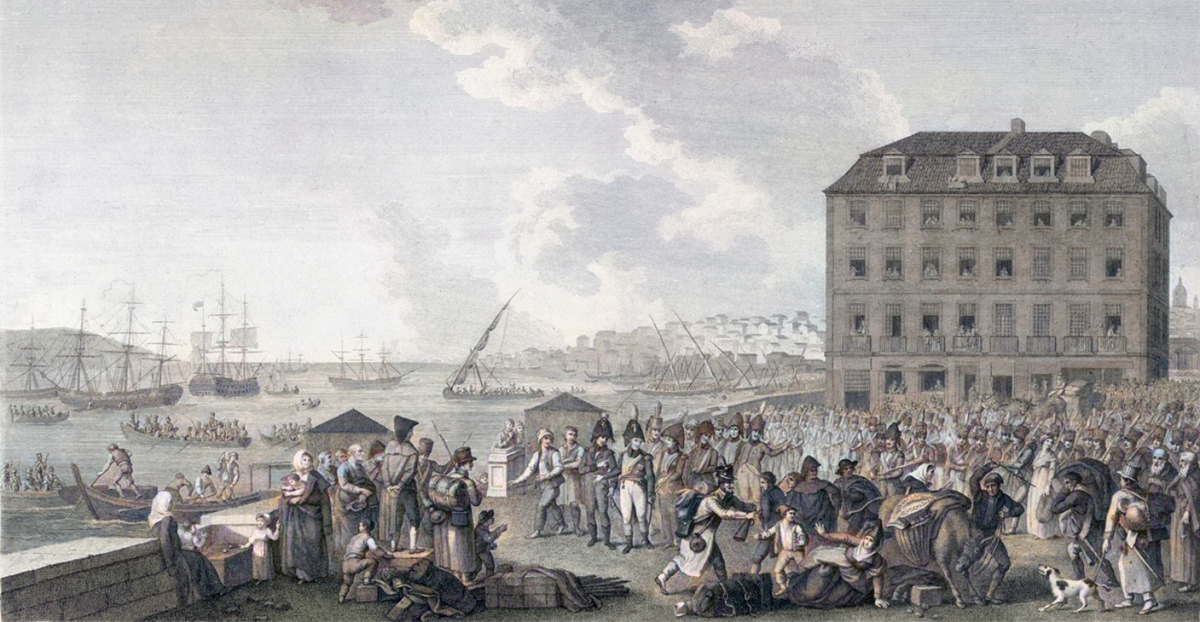
French and British forces sign Sintra Convention leading to French evacuation from Portugal.
Portugal

'/%3e%3c/g%3e%3cuse xlink:href='%23d' x='45.714'/%3e%3cuse xlink:href='%23e' transform='matrix(-1 0 0 1 479.792 0)'/%3e%3cg id='f' fill='%23fff'%3e%3cpath fill='%23039' d='M232.636 202.406v.005c0 2.212.85 4.227 2.212 5.69 1.365 1.466 3.245 2.377 5.302 2.377 2.067 0 3.944-.905 5.303-2.365 1.358-1.459 2.202-3.472 2.202-5.693v-10.768l-14.992-.013-.028 10.766'/%3e%3ccircle cx='236.074' cy='195.735' r='1.486'/%3e%3ccircle cx='244.392' cy='195.742' r='1.486'/%3e%3ccircle cx='240.225' cy='199.735' r='1.486'/%3e%3ccircle cx='236.074' cy='203.916' r='1.486'/%3e%3ccircle cx='244.383' cy='203.905' r='1.486'/%3e%3c/g%3e%3cuse xlink:href='%23f' y='-26.016'/%3e%3cuse xlink:href='%23f' x='-20.799'/%3e%3cuse xlink:href='%23f' x='20.745'/%3e%3cuse xlink:href='%23f' y='25.784'/%3e%3c/svg%3e)
Military Political
9 min read
Updated By: History Editorial Network (HEN)
Published:
On August 30, 1808, the Convention of Sintra was signed between French and British forces, marking a pivotal moment in the Peninsular War, which was a significant theater of the Napoleonic Wars. The convention led to the evacuation of French troops from Portugal and had far-reaching consequences, both militarily and politically.
Background: The Peninsular War and French Occupation
In 1807, under orders from Napoleon Bonaparte, French forces invaded Portugal to enforce the Continental System, a blockade designed to cripple Britain’s economy. Portugal, an ally of Britain, refused to comply, leading to the French occupation of the country. The Portuguese royal family fled to Brazil, leaving the nation under French control.
The French occupation, under the command of General Junot, faced growing resistance from the Portuguese population, supported by British forces. The situation escalated into the broader conflict known as the Peninsular War, which involved France, Spain, Portugal, and Britain in a struggle for control over the Iberian Peninsula.
The British Intervention
In 1808, the British decided to take direct military action against the French occupation of Portugal. Sir Arthur Wellesley, who would later become the Duke of Wellington, led a British expeditionary force to the Portuguese coast. After landing in August 1808, Wellesley quickly achieved several victories against the French forces, most notably at the Battle of Vimeiro on August 21, 1808.
Despite Wellesley's successes, command of the British forces was soon transferred to more senior officers, Sir Harry Burrard and Sir Hew Dalrymple. Both commanders were more cautious than Wellesley, and this shift in leadership would directly influence the events that led to the Convention of Sintra.
The Convention of Sintra
After the defeat at Vimeiro, the French, led by General Junot, found themselves in a precarious position. However, rather than pressing their advantage, the British commanders, particularly Dalrymple, opted to negotiate. This decision led to the signing of the Convention of Sintra on August 30, 1808, at the Palace of Queluz, near Lisbon.
The terms of the convention were surprisingly lenient toward the French. The agreement allowed the French army to evacuate Portugal with all their equipment, arms, and loot, and they were transported back to France by British ships. Furthermore, the convention permitted the French to return home without being treated as prisoners of war.
Consequences and Controversy
The Convention of Sintra immediately sparked outrage in Britain and among the Portuguese. Many viewed the terms as a betrayal of the sacrifices made by the Portuguese people and British soldiers. The British public and press were particularly incensed that the French were allowed to leave with their plunder, which included valuables taken from Portuguese churches and homes.
In response to the outcry, the British government ordered an inquiry, known as the "Sintra Inquiry," to investigate the actions of the British commanders. While Wellesley was cleared of any wrongdoing, both Burrard and Dalrymple were recalled to England and faced severe criticism, effectively ending their military careers.
Despite the controversy, the Convention of Sintra had the immediate effect of liberating Portugal from French control, a significant victory for the British-Portuguese alliance. It marked the beginning of a long and arduous campaign that would eventually see the expulsion of French forces from the Iberian Peninsula and contribute to Napoleon’s downfall.
Legacy
The Convention of Sintra is remembered as a controversial episode in the Napoleonic Wars. While it achieved the objective of freeing Portugal from French occupation, the leniency shown to the French forces remains a point of historical debate. For Portugal, the convention marked the start of its liberation and the beginning of its role as a critical ally in the broader conflict against Napoleonic France.
#PeninsularWar #ConventionOfSintra #NapoleonicWars #PortugalHistory #BritishArmy #FrenchArmy #ArthurWellesley #MomentsOfLife #MoofLife_Moment #MoofLife
Primary Reference
Convention of Cintra

Explore the Life Moments of
 AI Twin