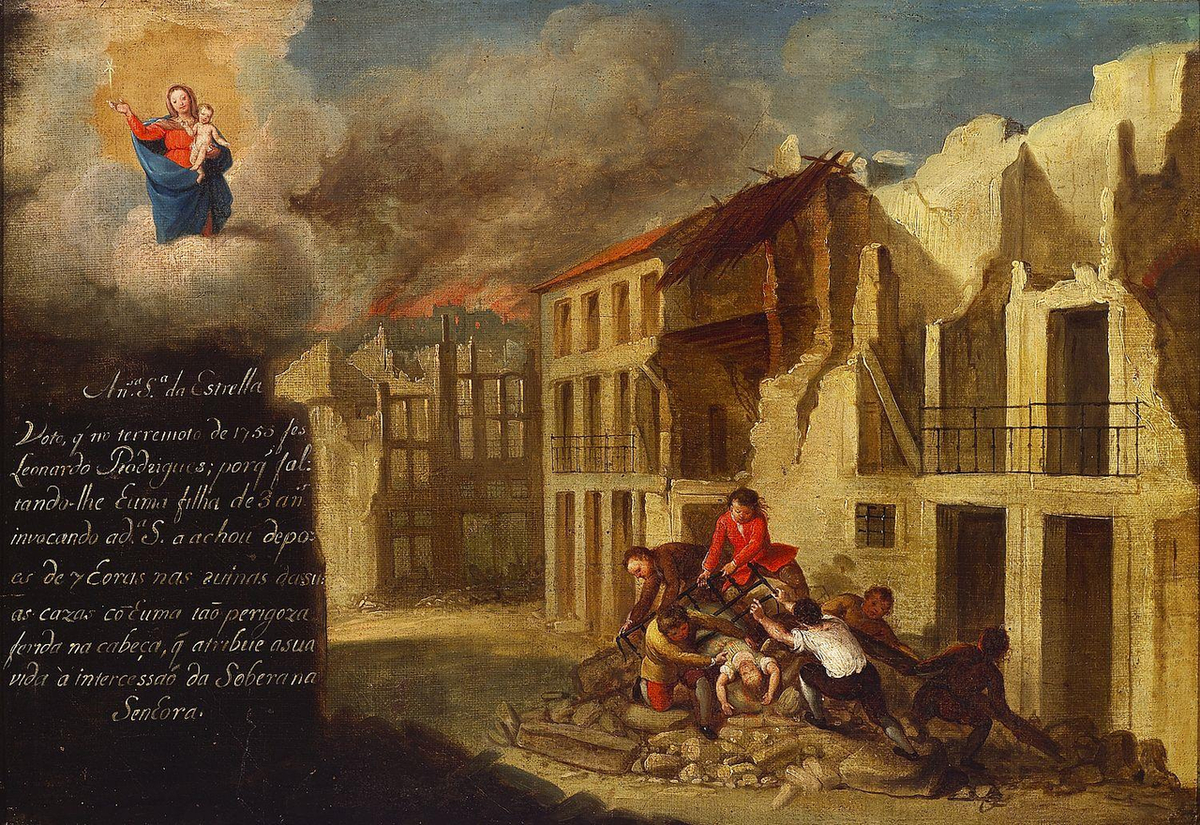
Devastating natural disasters hit Lisbon causing widespread destruction and loss of life.
Portugal
'/%3e%3c/g%3e%3cuse xlink:href='%23d' x='45.714'/%3e%3cuse xlink:href='%23e' transform='matrix(-1 0 0 1 479.792 0)'/%3e%3cg id='f' fill='%23fff'%3e%3cpath fill='%23039' d='M232.636 202.406v.005c0 2.212.85 4.227 2.212 5.69 1.365 1.466 3.245 2.377 5.302 2.377 2.067 0 3.944-.905 5.303-2.365 1.358-1.459 2.202-3.472 2.202-5.693v-10.768l-14.992-.013-.028 10.766'/%3e%3ccircle cx='236.074' cy='195.735' r='1.486'/%3e%3ccircle cx='244.392' cy='195.742' r='1.486'/%3e%3ccircle cx='240.225' cy='199.735' r='1.486'/%3e%3ccircle cx='236.074' cy='203.916' r='1.486'/%3e%3ccircle cx='244.383' cy='203.905' r='1.486'/%3e%3c/g%3e%3cuse xlink:href='%23f' y='-26.016'/%3e%3cuse xlink:href='%23f' x='-20.799'/%3e%3cuse xlink:href='%23f' x='20.745'/%3e%3cuse xlink:href='%23f' y='25.784'/%3e%3c/svg%3e)

Natural Disaster
3 min read
Updated By: History Editorial Network (HEN)
Published:
Updated:
The Great Lisbon Earthquake was a catastrophic disaster that struck the city of Lisbon, Portugal. It began with a strong earthquake followed by a devastating tsunami and widespread fires that ravaged the city. The earthquake, estimated to have a magnitude of 8.5 to 9.0, caused buildings to collapse and streets to crumble. The following tsunami flooded the coastal areas, adding to the destruction. As fires broke out due to overturned candles and stoves, much of the city was engulfed in flames.
The impact of the Great Lisbon Earthquake was profound, resulting in the destruction of buildings, infrastructure, and homes. The death toll was substantial, with estimates ranging from 40,000 to 50,000 lives lost. The event also had far-reaching consequences beyond the immediate physical damage, leading to political and economic instability in Portugal.
In the aftermath, efforts were made to rebuild and restore the city of Lisbon. The disaster prompted advancements in understanding earthquakes and led to changes in urban planning and architecture to prevent similar devastation in the future. The Great Lisbon Earthquake remains a somber reminder of the unpredictable power of natural disasters.
#GreatDisaster #PortugalHistory
#LisbonEarthquake
Primary Reference
1755 Lisbon earthquake

Explore the Life Moments of
 AI Twin