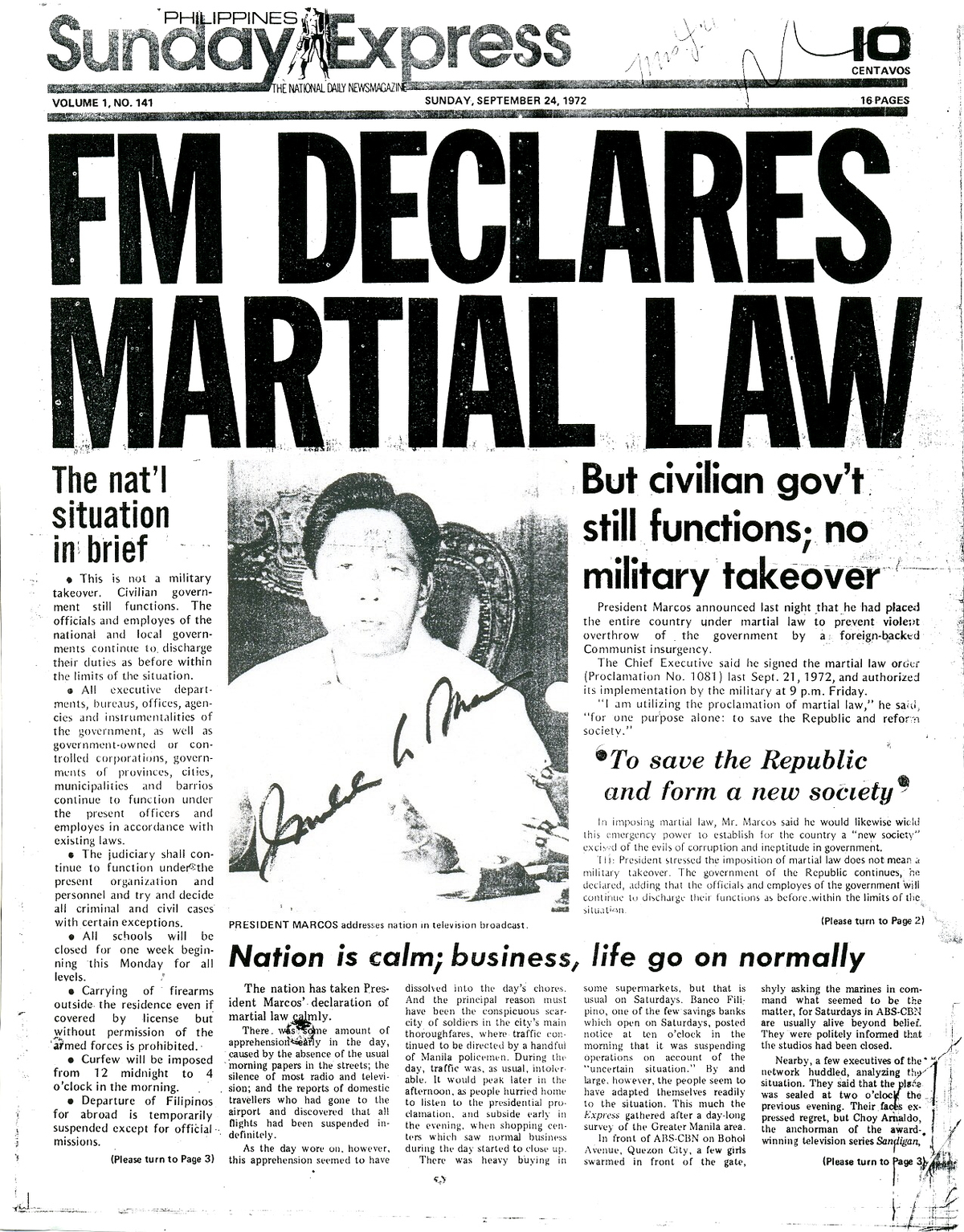
President Ferdinand Marcos Declares Martial Law
Philippines

Political
Human RightsAbuses
4 min read
Updated By: History Editorial Network (HEN)
Published:
In September 1972, President Ferdinand Marcos declared Martial Law in the Philippines. The political landscape leading up to this pivotal decision was marked by rising civil unrest, economic challenges, and the persistent threat of communist insurgency. Marcos justified the declaration as a necessary measure to restore law and order, combat corruption, and promote economic development.
The impact of Martial Law was far-reaching and significant. Basic civil liberties were suspended, media outlets were shut down, political opponents were arrested, and censorship was imposed. The military was granted extensive powers to maintain control, leading to human rights abuses and widespread fear among the population. The economy, controlled by Marcos' cronies, experienced growth but at the expense of increasing social inequality and poverty.
Despite the authoritarian rule, Marcos sought to legitimize his regime through a new constitution in 1973 and a re-election in 1981, both widely believed to be marred by fraud and coercion. The years under Martial Law were marked by a culture of fear and suppression, with dissent harshly punished.
The declaration of Martial Law by President Ferdinand Marcos in 1972 remains a contentious and divisive issue in Philippine history. It sparked a period of authoritarian rule that lasted for over a decade, leaving a lasting impact on the country's political, social, and economic landscape. The scars of Martial Law continue to be felt by the generations that lived through it, serving as a reminder of the dangers of unchecked power and the importance of upholding democracy and human rights.
#MartialLaw #FerdinandMarcos #PhilippinesHistory #Authoritarianism #HumanRightsAbuses

Explore the Life Moments of
 AI Twin