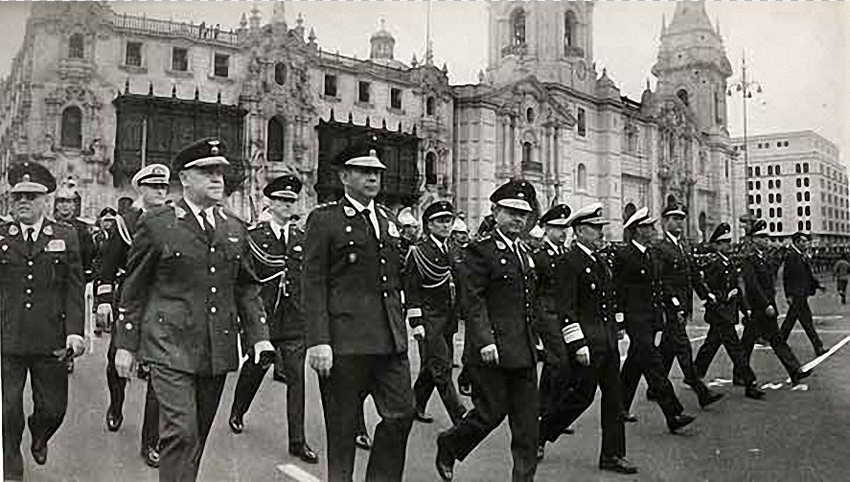
Coup d'état led by General Juan Velasco Alvarado
Peru
Political History
Agrarian Reform
Latin American Studies
3 min read
Updated By: History Editorial Network (HEN)
Published:
Updated:
On October 3, 1968, a significant coup d'état in Peru was executed by a group of military officers led by General Juan Velasco Alvarado. This event marked a pivotal moment in Peruvian history as it brought the army to power with a vision of 'social progress and integral development.' Velasco's regime was characterized by its nationalist and reformist approach, heavily influenced by the Economic Commission for Latin America and the Caribbean (CEPAL) theories regarding dependence and underdevelopment. One of the most notable actions taken by Velasco's government was the nationalization of the International Petroleum Corporation, which aimed to reclaim control over the country's natural resources. Additionally, the regime launched an extensive agrarian reform program, recognized as the largest of its kind in Latin America. This reform sought to redistribute land from large landowners to peasants, thereby modernizing agriculture and improving the livelihoods of rural communities. The impact of these reforms was profound, as they aimed to address historical inequalities and promote economic development in Peru. Velasco's policies, while controversial, set the stage for ongoing discussions about land reform and resource management in the region.

Explore the Life Moments of
 AI Twin