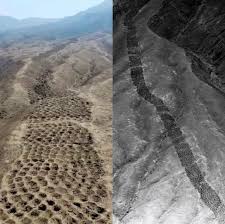
Archaeologists solve mystery of "Band of Holes" in Pisco Valley as pre-Inca barter market
Peru
4 min read
Updated By: History Editorial Network (HEN)
Published:
Updated:
Archaeologists in Peru have solved the long-standing mystery of the “Band of Holes” in the Pisco Valley, identifying the site as a pre-Inca barter market used by ancient Andean communities. The site, consisting of thousands of evenly spaced circular pits carved into the desert landscape, had puzzled researchers for decades regarding its purpose. Recent excavations and analyses revealed evidence of trade activity, including the presence of agricultural remains, tools, and artifacts indicating the exchange of goods such as maize, textiles, and ceramics. The arrangement of the pits suggests a highly organized system for storing, displaying, and possibly negotiating commodities, reflecting sophisticated economic practices among pre-Inca societies.
The discovery carries significant historical, cultural, and academic implications. Historically, it provides valuable insight into the social and economic organization of pre-Inca civilizations, demonstrating that barter and trade networks were highly developed in the region long before the rise of the Inca Empire. Culturally, the site highlights the ingenuity and planning of ancient Andean communities, offering a tangible connection to Peru’s rich heritage. Academically, the finding resolves a decades-old archaeological debate, opening new avenues for research into ancient trade systems, regional interaction, and community structures. Overall, the identification of the “Band of Holes” as a pre-Inca barter market represents a major contribution to understanding Andean history, shedding light on the complexity, organization, and economic sophistication of early societies in the Pisco Valley.

Explore the Life Moments of
 AI Twin