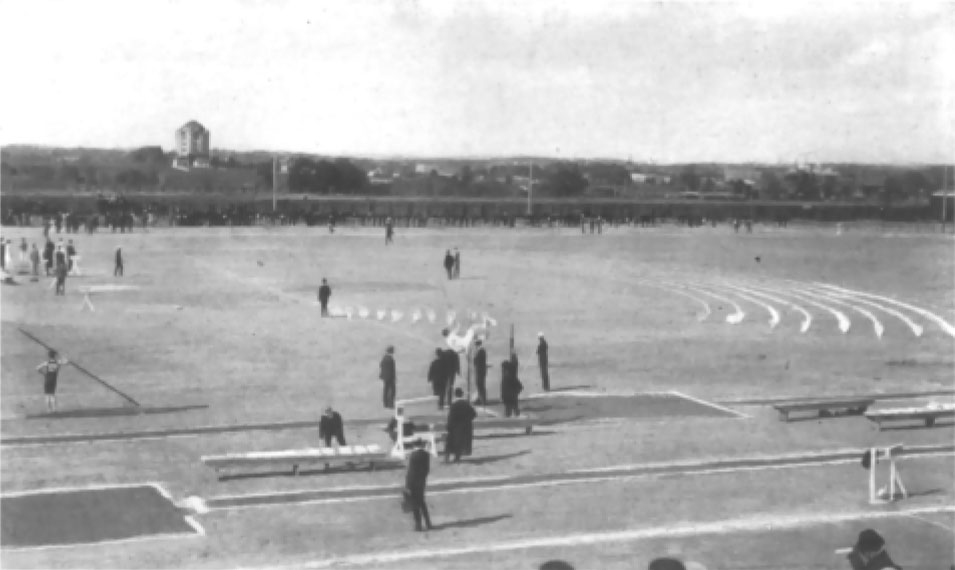
United States, St. Louis Olympics from 1-Jul-1904 to 23-Nov-1904
Greece
Sport
10 min read
Updated By: History Editorial Network (HEN)
Published:
The St. Louis Olympics of 1904 took place as part of the Louisiana Purchase Exposition, also known as the St. Louis World's Fair. The games were not initially intended to be part of the World's Fair but were eventually included as an attempt to attract more visitors. With relatively low international participation, the majority of athletes were from the United States, showcasing the country's growing interest in sports and physical fitness.
One of the most iconic moments of the St. Louis Olympics was the marathon race, which turned out to be a grueling test of endurance. The route was poorly planned, The 1904 Summer Olympics, held in St. Louis, Missouri, from July 1 to November 23, 1904, were the third modern Olympic Games and the first to be hosted outside of Europe. The Games were held in conjunction with the Louisiana Purchase Exposition, commonly known as the St. Louis World's Fair, which celebrated the centennial of the Louisiana Purchase.
The decision to hold the Olympics in St. Louis was influenced by the World's Fair organizers, who saw the Games as a way to attract international attention and visitors. However, this association with the World's Fair led to several challenges, including a prolonged schedule and logistical difficulties. The Games were spread over several months, making it difficult for international athletes to participate, and many events were poorly attended.
A total of 651 athletes from 12 countries participated in the 1904 St. Louis Olympics. The vast majority of competitors were from the United States, with only 62 athletes from outside the host nation. This limited international participation was due to the long and expensive journey to St. Louis, as well as the ongoing Russo-Japanese War, which prevented many European athletes from attending.
One of the most notable aspects of the 1904 Olympics was the diversity of events and the inclusion of sports that reflected American interests and culture. The Games featured traditional Olympic events such as athletics, swimming, and gymnastics, as well as more unusual sports like tug of war, roque (a variant of croquet), and plunge for distance (a diving event).
The athletics events were dominated by American athletes, who won 23 of the 25 track and field events. Notable performances included Archie Hahn, who won three gold medals in the 60 meters, 100 meters, and 200 meters sprints, earning him the nickname "The Milwaukee Meteor." Ray Ewry continued his dominance in the standing jump events, winning gold in the standing high jump and standing long jump.
The marathon at the 1904 Olympics became infamous for its chaotic and controversial nature. The race was held in extremely hot and humid conditions, and the course was poorly marked and inadequately supplied with water stations. Only 14 of the 32 starters finished the race. Thomas Hicks of the United States was declared the winner, despite receiving assistance from his trainers, who gave him strychnine and brandy during the race. Fred Lorz, another American, initially crossed the finish line first but was later disqualified for having hitched a ride in a car for part of the course.
The swimming events took place in an artificial lake on the World's Fair grounds, with competitors swimming in open water. Charles Daniels of the United States was the standout swimmer, winning gold medals in the 220 yards, 440 yards, and 100 yards freestyle events.
The 1904 St. Louis Olympics also saw the introduction of wrestling as an Olympic sport, with freestyle wrestling being featured. George Mehnert and Bernhoff Hansen were among the notable wrestlers who won gold medals for the United States.
One of the more controversial aspects of the 1904 Olympics was the inclusion of "Anthropology Days," an event organized by the World's Fair that featured indigenous people from various countries competing in traditional sports and activities. These events were criticized for being exploitative and demeaning, as they were more of a spectacle for fairgoers than a legitimate athletic competition.
Despite the challenges and controversies, the 1904 St. Louis Olympics contributed to the development of the Olympic movement in several ways. The Games showcased a wide range of sports and athletic disciplines, reflecting the growing diversity of the Olympic program. They also highlighted the need for better organization and international cooperation in hosting the Olympics.
The legacy of the 1904 St. Louis Olympics is a mixed one, marked by both significant achievements and notable shortcomings. While the Games were not as well-organized or well-attended as their predecessors, they played a crucial role in the evolution of the modern Olympics and set the stage for future improvements in the planning and execution of the Games.
The 1904 Olympics also underscored the importance of ensuring that the Games remain a truly international event, accessible to athletes from around the world. The lessons learned from the St. Louis Olympics helped shape the future direction of the Olympic movement, leading to more inclusive and better-organized Games in subsequent years.
#MomentsOfLife #MoofLife_Moment #MoofLife #StLouisOlympics #UnitedStates #OlympicHistory
Primary Reference
St. Louis 1904 Summer Olympics - Athletes, Medals & Results

Explore the Life Moments of
 AI Twin