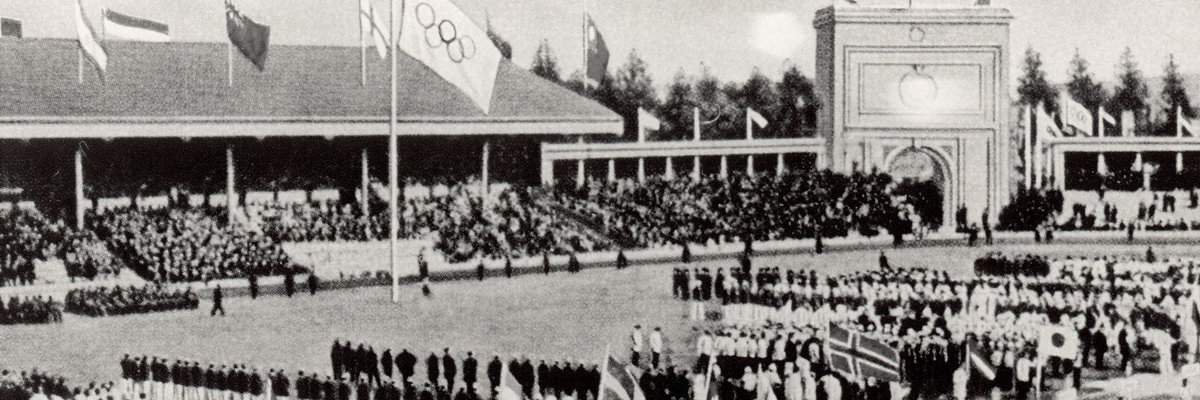
Belgium, Antwerp Olympics from 14-Aug-1920 to 12-Sep-1920
Greece
Sport
10 min read
Updated By: History Editorial Network (HEN)
Published:
The 1920 Summer Olympics, held in Antwerp, Belgium, from August 14 to September 12, 1920, were a significant event in the history of the modern Olympic Games. Coming on the heels of World War I, the Games symbolized a hopeful return to international harmony and athletic competition. Antwerp was chosen as the host city to honor Belgium, which had suffered greatly during the war.
These Games were characterized by the spirit of rebuilding and peace. The Olympic flag, with its five interlocking rings symbolizing the unity of the five inhabited continents, was introduced for the first time. The Olympic Oath, taken by an athlete on behalf of all competitors, was also introduced to emphasize fair play and sportsmanship. The anthem composed by Spiros Samaras, with lyrics by Kostis Palamas, was used for the first time as the Olympic Anthem.
A total of 2,626 athletes from 29 countries participated in the 1920 Antwerp Olympics, competing in 154 events across 22 sports. These Games saw the return of many nations, including the United States, which sent the largest delegation. However, countries that had been part of the Central Powers during World War I, such as Germany, Austria, Hungary, and Bulgaria, were not invited to participate.
The opening ceremony on August 14, 1920, was a poignant event, attended by King Albert I of Belgium and Queen Elisabeth. The ceremony began with a military parade to honor the fallen soldiers of the Great War, followed by the athletes' parade. The athletes marched into the stadium behind their national flags, and the Olympic flag was raised for the first time. Victor Boin, a Belgian water polo player and fencer, took the inaugural Olympic Oath on behalf of all competitors.
In athletics, the United States once again dominated the track and field events, winning 9 gold medals. Notable performances included Charles Paddock, who won gold in the 100 meters, and Jackson Scholz, who triumphed in the 200 meters. Finland's Paavo Nurmi, known as the "Flying Finn," made a remarkable debut by winning three gold medals in the 10,000 meters, 8,000 meters cross-country, and 3,000 meters team race. Nurmi's dominance in distance running would continue in future Olympics, solidifying his status as one of the greatest athletes of all time.
The swimming events were held in the newly constructed Olympic Swimming Stadium, featuring a 100-meter pool. Duke Kahanamoku of the United States, who had made a name for himself in the 1912 Stockholm Olympics, continued his success by winning gold in the 100 meters freestyle and silver in the 4x200 meters freestyle relay. Ethelda Bleibtrey, also from the United States, won three gold medals in the women's 100 meters freestyle, 300 meters freestyle, and 4x100 meters freestyle relay.
The 1920 Antwerp Olympics also saw the introduction of women's gymnastics as an Olympic sport. The gymnastics events included both individual and team competitions. The women's team competition was won by the Netherlands, marking their first gold medal in Olympic history.
In fencing, Nedo Nadi of Italy achieved a remarkable feat by winning five gold medals in foil, épée, and sabre events. Nadi's versatility and skill in multiple fencing disciplines set a record that remains unmatched in Olympic history.
The Antwerp Olympics also featured the debut of several sports, including hockey and figure skating. The hockey tournament was won by Great Britain, while figure skating events were held as part of the Summer Olympics before being moved to the Winter Olympics. Gillis Grafström of Sweden won gold in men's singles figure skating, while Magda Julin of Sweden won gold in women's singles.
One of the most memorable moments of the 1920 Antwerp Olympics was the participation of Oscar Swahn, a Swedish shooter who, at the age of 72, became the oldest Olympic competitor and medalist. Swahn won a silver medal in the running deer team event, adding to his already impressive collection of Olympic medals.
The 1920 Antwerp Olympics were also notable for the introduction of the Olympic Oath and the Olympic flag, both of which have become enduring symbols of the Games. The Olympic Oath, taken by Victor Boin, emphasized the values of fair play and sportsmanship, while the Olympic flag, with its five interlocking rings, represented the unity and friendship of the world's nations.
The closing ceremony on September 12, 1920, marked the end of a historic and successful Olympic Games. Medals were awarded to the winners, and the athletes bid farewell to Antwerp, leaving behind a legacy of hope and reconciliation. The 1920 Antwerp Olympics demonstrated the power of sports to bring people together and promote peace in the aftermath of conflict.
#MomentsOfLife #MoofLife_Moment #MoofLife #AntwerpOlympics #Belgium1920 #SportsDiplomacy #OlympicLegacy
Primary Reference
Antwerp 1920: a symbol of peace and unity 100 years after the Games

Explore the Life Moments of
 AI Twin