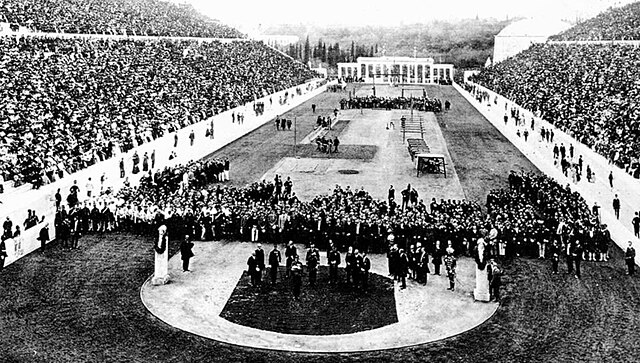
Greece, Athens Olympics from 06-Apr-1896 to 15-Apr-1896
Greece

Sport
10 min read
Updated By: History Editorial Network (HEN)
Published:
In April 1896, Athens hosted the first modern Olympic Games. The event marked a significant moment in sports history, reviving the ancient tradition of the Olympic Games. With 14 participating countries and 241 athletes, the games showcased a range of sporting events, including athletics, swimming, cycling, fencing, and weightlifting.
The inaugural modern Olympic Games, held in Athens, Greece from April 6 to April 15, 1896, marked the revival of an ancient tradition that dates back to 776 BC. Spearheaded by Baron Pierre de Coubertin, the founder of the International Olympic Committee (IOC), the 1896 Games aimed to unite the world through sports and promote peace and international understanding.
Athens was chosen as the host city for the first modern Olympics due to its historical significance as the birthplace of the ancient Games. The Greek government and people embraced the idea enthusiastically, and despite initial financial and organizational challenges, they successfully prepared the city for the international event.
The Panathenaic Stadium, originally built in 330 BC and refurbished in marble for the 1896 Games, served as the main venue. The stadium, with its seating capacity of around 70,000 spectators, became a symbol of the ancient heritage and the modern revival of the Olympic spirit.
A total of 241 athletes from 14 countries participated in the 1896 Olympics. The participating nations included Australia, Austria, Bulgaria, Chile, Denmark, France, Germany, Great Britain, Greece, Hungary, Italy, Sweden, Switzerland, and the United States. Notably, women were not allowed to compete in these Games, a decision that would be rectified in future editions.
The opening ceremony on April 6, 1896, was a grand affair, attended by around 80,000 spectators, including King George I of Greece and members of the royal family. The event began with the athletes parading into the Panathenaic Stadium, followed by speeches and the raising of the national flags. Spiridon Louis, a Greek water carrier, had the honor of lighting the Olympic flame, symbolizing the commencement of the Games.
The athletic events in the 1896 Olympics included a variety of disciplines such as athletics, cycling, fencing, gymnastics, shooting, swimming, tennis, weightlifting, and wrestling. One of the most anticipated events was the marathon, inspired by the ancient Greek legend of Pheidippides, who ran from Marathon to Athens to deliver news of the Greek victory in the Battle of Marathon.
The marathon race, covering a distance of approximately 40 kilometers (25 miles), took place on April 10, 1896. Spiridon Louis emerged as the hero of the Games by winning the marathon in 2 hours, 58 minutes, and 50 seconds. His victory was celebrated with immense national pride, and he became an enduring symbol of Greek endurance and determination.
In athletics, American athletes dominated the track and field events. James Connolly won the triple jump, becoming the first modern Olympic champion, while Thomas Burke won the 100 meters and 400 meters sprints. Other notable American athletes included Robert Garrett, who won the discus throw and shot put, and Ellery Clark, who triumphed in the high jump and long jump.
The swimming events were held in the Bay of Zea, in the open sea, posing a challenge for the competitors due to the cold water and choppy conditions. Alfred Hajos of Hungary emerged as the star swimmer, winning gold medals in the 100 meters freestyle and the 1200 meters freestyle.
In gymnastics, Germany's Hermann Weingärtner and Carl Schuhmann were standout performers. Weingärtner won a total of six medals, including three golds, while Schuhmann won four golds across gymnastics and wrestling.
Fencing was another highlight of the 1896 Olympics, with athletes competing in events such as foil, sabre, and épée. Leonidas Pyrgos of Greece won the gold medal in the masters' foil, becoming the first Greek fencer to achieve this honor.
The 1896 Olympics also saw the introduction of tennis as an Olympic sport. John Pius Boland of Great Britain and Ireland won the men's singles and, partnering with Friedrich Traun of Germany, also claimed the men's doubles title.
The closing ceremony on April 15, 1896, marked the end of a historic and successful event. King George I awarded the winners with silver medals, olive branches, and diplomas. Unlike today's tradition, there were no gold medals awarded; the runners-up received copper medals.
The legacy of the 1896 Athens Olympics extended beyond the sporting achievements. It established the foundation for the modern Olympic movement, promoting the values of fair play, international friendship, and the pursuit of excellence. The success of the Games encouraged the IOC to continue organizing the Olympics every four years, leading to the growth and evolution of the event into the global spectacle it is today.
The 1896 Olympics also highlighted the importance of overcoming challenges and uniting people from diverse backgrounds through sports. The spirit of the ancient Games was revived, inspiring future generations to participate in and celebrate the Olympics as a symbol of peace and unity.
#MomentsOfLife #MoofLife_Moment #MoofLife #AthensOlympics #RevivaloftheOlympicGames #InternationalUnity #SportingLegacy
Primary Reference
Athens 1896 Summer Olympics - Athletes, Medals & Results

Explore the Life Moments of
 AI Twin