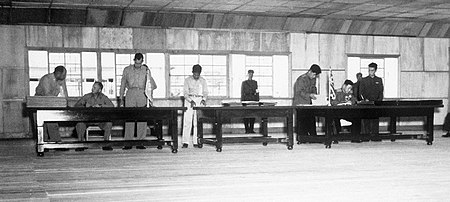
Korean Armistice Agreement signed
North Korea
Political
4 min read
Updated By: History Editorial Network (HEN)
Published:
Updated:
The Korean Armistice Agreement was a crucial event marking the cessation of active combat between the military forces involved in the Korean War. After lengthy negotiations, the agreement was signed by the United Nations Command, the Korean People's Army, and the Chinese People's Volunteer Army. The signing took place in Panmunjom, a village in the demilitarized zone (DMZ) that divides North and South Korea.
The war had begun earlier when North Korean forces advanced southward across the 38th parallel, leading to a full-scale conflict involving South Korean forces and their United Nations allies. The war caused significant casualties on both sides, with estimates of military and civilian deaths and injuries reaching into the millions.
Despite the cessation of hostilities, the agreement did not serve as a formal peace treaty. Consequently, the Korean Peninsula remains in a state of technical warfare, with the DMZ acting as a buffer zone to prevent further conflict. The DMZ runs approximately 250 kilometers long and 4 kilometers wide, forming one of the most fortified borders in the world.
The armistice provisions included the creation of a Military Armistice Commission (MAC) to oversee the execution of the agreement, mutual repatriation of prisoners of war (POWs), and measures to prevent the incursion of hostile acts. While the armistice temporarily halted the advancement of war, tensions persisted, influencing international relations and military policies for decades.
The Korean Armistice Agreement thus had a profound impact on the geopolitical landscape of the region, maintaining a fragile peace while leaving the core issues that started the war unresolved.
#Ceasefire #KoreanPeninsula #Panmunjom #ColdWar #MilitaryHistory #DMZ #MoofLife
Explore the Life Moments of
 AI Twin