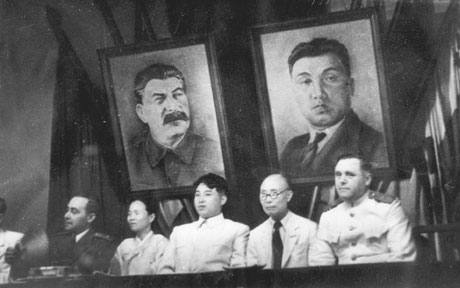
Soviet-backed Kim Il Sung rises to power, shapes North Korea's communist regime.
North Korea
Political
4 min read
Updated By: History Editorial Network (HEN)
Published:
Following the end of World War II, the Korean Peninsula found itself divided along the 38th parallel, with Soviet forces occupying the north. During this period, the Soviet authorities sought to establish a reliable leadership in the northern region of Korea. They selected Kim Il Sung, a seasoned anti-Japanese guerrilla fighter, to take on this role. Kim was introduced to the North Korean public as a key figure in the resistance against Japanese imperialism.
The introduction of Kim Il Sung played a fundamental role in shaping North Korea's political structure. His background as a guerrilla fighter appealed to the populace, who had endured years of Japanese occupation. The Soviet Union supported Kim's ascendancy to ensure that North Korea would align with socialist principles and establish a government friendly to Moscow.
Kim Il Sung's introduction was a carefully orchestrated event involving public speeches, newspaper articles, and propaganda materials. These efforts aimed at building his image as a hero of the Korean resistance movement. The outcome was the solidification of Kim Il Sung's leadership and the eventual establishment of a communist regime in North Korea.
The impact of this introduction was profound. It led to the formation of the Democratic People's Republic of Korea (DPRK) and set the stage for the Kim dynasty, which continues to rule the country to this day. Kim Il Sung's presentation as a guerrilla hero helped to foster a strong sense of nationalism and resistance among the North Korean people, laying the groundwork for the country's future policies and ideological stances.
#MoofLife #NorthKorea #KimIlSung #SovietUnion #GuerrillaHero #PoliticalHistory #ColdWar #Communism
Primary Reference
North Korea - a country study
Explore the Life Moments of
 AI Twin