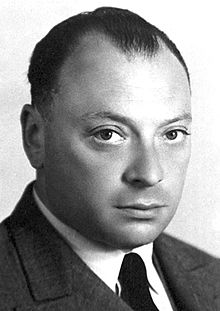
Wolfgang Pauli: Nobel Prize for Exclusion Principle's Impact on Quantum Mechanics and Modern Physics.
Sweden
Science
Technology
4 min read
Updated By: History Editorial Network (HEN)
Published:
Wolfgang Pauli received the Nobel Prize in Physics for his discovery of the Exclusion Principle, also known as the Pauli Principle, a fundamental rule in quantum mechanics. Pauli's principle states that no two electrons in an atom can have the same set of quantum numbers, meaning they cannot occupy the same quantum state simultaneously. This discovery was crucial for understanding the structure of atoms and the behavior of electrons in various elements.
Pauli's work significantly impacted the development of quantum mechanics and modern physics. The Exclusion Principle helped scientists explain the arrangement of elements in the periodic table and provided a deeper understanding of chemical bonding and the properties of matter. It laid the groundwork for advancements in particle physics, semiconductor technology, and the development of quantum computers.
Other notable physicists contemporaneous to Pauli included Niels Bohr, Werner Heisenberg, and Erwin Schrödinger, who also contributed significantly to quantum theory. Pauli's Exclusion Principle was an essential complement to these contributions, emphasizing the interplay between different scientific disciplines in making groundbreaking discoveries.
The recognition of Pauli's work through the Nobel Prize highlighted the importance of theoretical physics in providing a coherent framework for experimental findings. It also underscored the collaborative nature of scientific progress, where theoretical insights and empirical evidence jointly advance human understanding of the natural world.
#PhysicsNobelPrize #QuantumMechanics #ExclusionPrinciple #WolfgangPauli #ScientificDiscovery #MoofLife
Primary Reference
Nobel Prize in Physics 1945 - Presentation Speech - NobelPrize.org
Explore the Life Moments of
 AI Twin