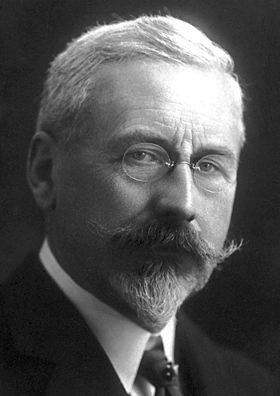
Charles Edouard Guillaume: Nobel laureate for discoveries in nickel steel alloys revolutionizing precision measurements.
Sweden
Science
Technology
4 min read
Updated By: History Editorial Network (HEN)
Published:
Charles Edouard Guillaume, a Swiss physicist, was awarded the Nobel Prize in Physics in recognition of his discovery of anomalies in nickel steel alloys, which had a significant impact on precision measurements in physics. Guillaume's work revolved around the study of Invar and Elinvar, materials known for their minimal expansion and elasticity over temperature variations.
Guillaume's discovery was critical for various scientific applications needing high precision, including timekeeping and the manufacturing of scientific instruments. His identification of the specific properties of nickel-steel alloys revolutionized the approach to creating and using materials under various thermal conditions. The predictability and stability of these alloys were instrumental in improving the accuracy of devices such as clocks, which had a profound effect on navigation and time measurement.
The impact of Guillaume’s work extended beyond academic and scientific spheres, influencing industries that relied heavily on precision engineering. His research provided a practical solution to one of the long-standing problems in physics and engineering and paved the way for advancements in technologies that demanded high accuracy.
Overall, Guillaume's contributions were acknowledged for bridging the gap between theoretical physics and practical applications, making high-precision measurements more reliable and accessible. #MoofLife #Physics #NobelPrize #PrecisionEngineering #ScientificDiscovery
Primary Reference
The watchmaker who registered the very first Swiss (...)
Explore the Life Moments of
 AI Twin