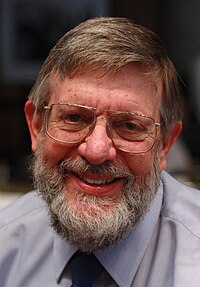
Nobel Prize-winning trio revolutionizes atomic physics with groundbreaking laser cooling methods.
Sweden
Science
Technology
5 min read
Updated By: History Editorial Network (HEN)
Published:
Steven Chu, Claude Cohen-Tannoudji, and William D. Phillips were awarded the Nobel Prize in Physics for their significant contributions to the field of atomic physics. They developed groundbreaking methods for cooling and trapping atoms using laser light, a discovery that has had profound effects on precision measurement and quantum physics.
Their work laid the foundation for laser cooling techniques, particularly important for experiments requiring extremely low temperatures and high-precision measurements. Chu, a physicist from the United States, pioneered the use of laser light to slow down and manipulate the motion of atoms. Cohen-Tannoudji, a French physicist, contributed by developing theoretical frameworks and experimental techniques that refined the process of cooling atoms. Phillips, another American physicist, further enhanced these methods, enabling the achievement of temperatures approaching absolute zero.
This research has opened doors to new experiments and technologies, including the development of atomic clocks with unprecedented accuracy, which are used in global positioning systems and in fundamental studies of time and space. Laser cooling and trapping techniques also allow for precise manipulation of atomic states, which is essential in the advancement of quantum computing and quantum simulation.
In their experiments, the absorption and emission of photons by atoms in a laser beam were used to gradually reduce the kinetic energy of the atoms. This process, often referred to as Doppler cooling, results in temperatures only a fraction of a degree above absolute zero. By utilizing multiple laser beams, a configuration known as "optical molasses" was created, where atoms experience a viscous force that slows them down and holds them in place.
The implications of their work on cooling and trapping atoms extend beyond academic research. Technological applications stemming from this field are pushing the boundaries of sensor technology and have promising implications for future advancements in materials science and nanotechnology.
#MoofLife #PhysicsInnovation #LaserCooling #QuantumLeap #NobelPrizePhysics #AtomicTechnology
Primary Reference
Award ceremony speech - NobelPrize.org
Explore the Life Moments of
 AI Twin