Nobel Prize-Winning Discovery: Electron Diffraction by Crystals and Quantum Mechanics Milestone.
Sweden
Science
5 min read
Updated By: History Editorial Network (HEN)
Published:
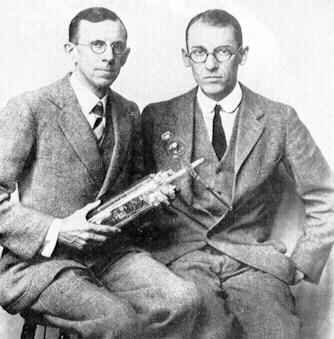
Clinton Davisson and George Paget Thomson were awarded the Nobel Prize in Physics for their discovery of electron diffraction by crystals. This achievement marked a significant milestone in the understanding of quantum mechanics and solid-state physics. The background to their discovery began with experimental work on the behavior of electrons when they encounter crystal lattices.
Davisson, an American physicist, conducted his research at Bell Telephone Laboratories. He initially observed unexpected patterns when electrons were scattered by a nickel target. Upon further investigation, he realized that these patterns resembled those predicted by the wave-like behavior of particles according to quantum theory. Independently, George Paget Thomson, a British physicist and the son of renowned physicist J.J. Thomson, conducted similar experiments involving electron beams passing through thin metal films. Thomson's results corroborated the wave-like nature of electrons, as predicted by quantum mechanics.
The confirmation of electron diffraction by crystals provided empirical support for Louis de Broglie's hypothesis that particles could exhibit both wave-like and particle-like properties. The implications were profound, as it strengthened the credibility of quantum mechanics and contributed to the development of technologies that rely on the wave properties of electrons, such as electron microscopy.
Their discovery had several scientific and practical impacts. It facilitated advancements in material science, allowing for a deeper understanding of crystal structures and properties. This understanding paved the way for innovations in various fields, including semiconductors and nanotechnology. Furthermore, the methodologies developed through their experiments proved invaluable in various applications, including the study of complex materials and the advancement of quantum theory.
The awarding of the Nobel Prize to Davisson and Thomson reinvigorated interest in the study of diffraction phenomena and affirmed the importance of experimental verification in the progress of theoretical physics.
#NobelPrize #Physics #QuantumMechanics #ElectronDiffraction #ScientificDiscovery #MoofLife
Primary Reference
Nobel Prize in Physics 1937 - Presentation Speech - NobelPrize.org
Explore the Life Moments of
 AI Twin