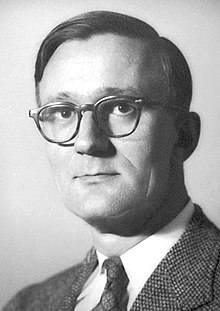
Nobel Prize laureates Lamb and Kusch advance physics with groundbreaking research in quantum electrodynamics.
Sweden
Science
4 min read
Updated By: History Editorial Network (HEN)
Published:
In one instance of profound recognition, the Nobel Prize in Physics was awarded to Willis E. Lamb and Polykarp Kusch. Lamb's landmark research on the hydrogen fine structure involved precise spectroscopy measurements, revealing tiny energy level shifts, later termed the Lamb shift. These findings challenged the existing theoretical framework, leading to refinements in quantum electrodynamics (QED).
Concurrently, Polykarp Kusch's pivotal work focused on the electron's magnetic moment. By employing meticulous experimental techniques, Kusch determined that the electron's magnetic moment slightly deviated from the value predicted by Dirac's theory. This discovery provided important empirical support for Quantum Electrodynamics, helping to establish the theory's validity through observable phenomena.
Their collective contributions significantly advanced the understanding of atomic and subatomic particles, influencing numerous fields within physics. The Lamb shift and refined electron magnetic moment measurements have become fundamental to particle physics studies and practical applications involving advanced spectroscopy and magnetic resonance technologies.
Lamb and Kusch's achievements underscored the importance of precise experimental physics in shaping theoretical advancements, bridging gaps between observation and theory. This recognition affirmed the critical role of experimental rigor in unveiling the nuances of fundamental particles.
#PhysicsResearch #QuantumElectrodynamics #NobelPrize #ExperimentalPhysics #AtomicPhysics #MoofLife
Primary Reference
Willis Lamb - Wikipedia
Explore the Life Moments of
 AI Twin