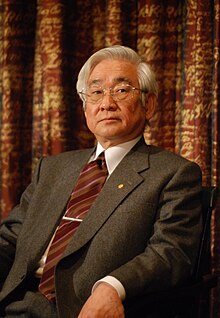
Nobel Prize honors groundbreaking discoveries in particle physics and symmetry breaking.
Sweden
Science
4 min read
Updated By: History Editorial Network (HEN)
Published:
Yoichiro Nambu was honored for his groundbreaking discovery of spontaneous broken symmetry in the field of subatomic physics. His work fundamentally changed our understanding of particle interactions, revealing how symmetrical states spontaneously become asymmetrical, a process crucial for explaining various physical phenomena. This concept of spontaneous broken symmetry has provided insights into the behavior of different fundamental forces and the mass generation of particles.
Simultaneously, Makoto Kobayashi and Toshihide Maskawa were recognized for discovering the origin of broken symmetry that leads to the prediction of three families of quarks within the Standard Model of particle physics. Their theoretical framework explained the mechanism by which CP violation occurs, leading to differences between matter and antimatter in the universe. This discovery was instrumental in predicting the existence of the then-unknown top and bottom quarks, essential elements that were later confirmed through experimental physics.
These scientific contributions have significantly advanced the theoretical foundations of particle physics. Nambu's work paved the way for understanding the Higgs mechanism, for which Peter Higgs and others were subsequently awarded. The Kobayashi-Maskawa theory explained why the universe is composed predominantly of matter rather than an equal mix of matter and antimatter.
The Nobel Prize in Physics awarded to these scientists highlighted the collaborative and cumulative nature of scientific discovery. It underscored the importance of theoretical advancements in driving experimental research, leading to an enriched comprehension of the universe's fundamental building blocks.
#Physics #NobelPrize #SubatomicPhysics #SymmetryBreaking #QuarkFamilies #MoofLife
Explore the Life Moments of
 AI Twin