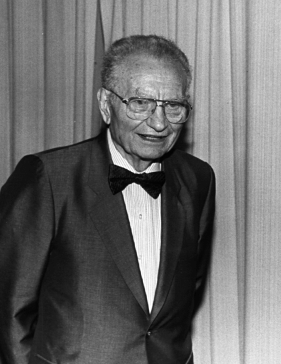
Paul Samuelson's Nobel Prize-Winning Contributions to Economic Theory and Methodology
Sweden
EconomicTheory
NobelPrize
3 min read
Updated By: History Editorial Network (HEN)
Published:
Paul A. Samuelson was awarded the Nobel Prize in Economic Sciences for his contributions to economic theory and methodology. Recognized for his work in both static and dynamic economic theory, Samuelson transformed the field of economics by introducing new analytical methods and enhancing mathematical rigor in economic analysis. His textbook "Economics: An Introductory Analysis" played a significant role in disseminating key economic concepts to students and academics alike and became one of the most widely used economics textbooks globally.
Throughout his career, Samuelson's research addressed various economic issues, from consumer behavior to capital theory, public goods, and welfare economics. His work often bridged the gap between abstract theory and practical application, influencing economic policy and decision-making. By formalizing and expanding economic theory, Samuelson helped lay the foundation for many modern economic principles and models.
Samuelson's award marked a milestone in the recognition of the importance of theoretical work in economics. His ability to make complex ideas accessible contributed significantly to raising the standard of economic education and research. His influence extended beyond academia, shaping the thinking of policymakers and economists worldwide.
#EconomicTheory #NobelPrize #PaulSamuelson #EconomicScience #MoofLife
Primary Reference
The Nobel Prizes - Economics
Explore the Life Moments of
 AI Twin