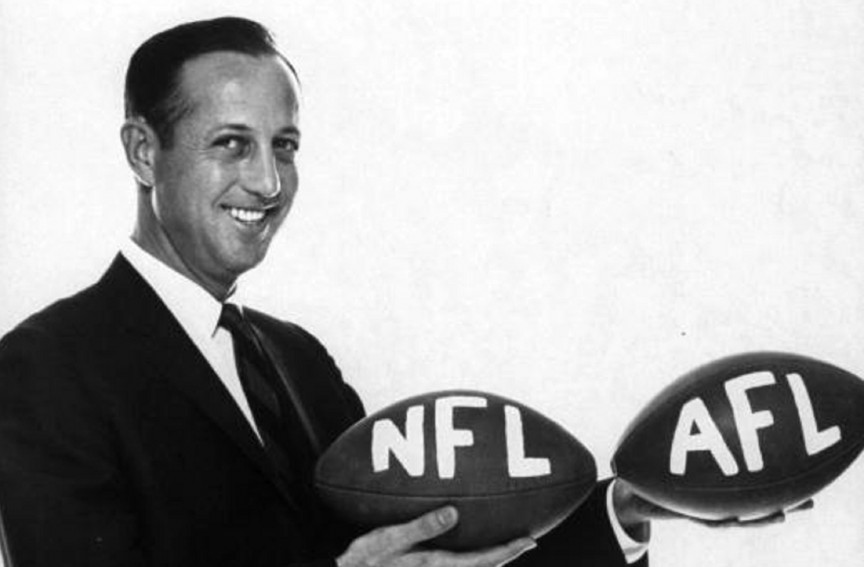
Completion of AFL-NFL Merger and League Reorganization
United Arab Emirates
Sports
Football
10 min read
Updated By: History Editorial Network (HEN)
Published:
Updated:
The year 1970 marked one of the most pivotal moments in professional football history - the completion of the AFL-NFL merger and the full reorganization of the National Football League (NFL) into the structure that continues to define the league today. After a decade of rivalry, competition, and eventual cooperation, this moment unified the sport under one professional banner and laid the foundation for the NFL's rise to national dominance.
The Road to Merger:
The American Football League (AFL) was formed in 1960 as a direct competitor to the NFL, offering a flashier, more open style of play, new markets, and a willingness to challenge the NFL's player contract practices. For ten years, the leagues operated separately but competitively, engaging in:
• Bidding wars for college talent, which inflated player salaries,
• Franchise expansion battles, and
• Fierce media competition, with separate television deals.
The turning point came in 1966, when both leagues agreed to merge, under pressure from rising operational costs and the desire for stability. That agreement included:
• The AFL-NFL merger was formally agreed upon on June 8, 1966, in New York, New York,
• A common draft starting in 1967,
• Interleague preseason games,
• The creation of an end-of-season championship game — now known as the Super Bowl (first played in January 1967),
• And full integration of schedules and operations by the 1970 season.
The 1970 Reorganization - Final Step of the Merger:
By 1970, the merger was complete. The NFL and AFL officially combined into a single league, with 26 teams (soon to grow):
• The 10 AFL teams joined with three NFL teams — the Pittsburgh Steelers, Cleveland Browns, and Baltimore Colts — to form the new American Football Conference (AFC).
• The remaining 13 NFL teams made up the National Football Conference (NFC).
This realignment was critical for maintaining competitive balance and parity between the leagues. It also marked the beginning of:
• A fully unified schedule, with interconference games,
• A shared television contract, enhancing national exposure, and
• A single playoff system culminating in the Super Bowl, which became the official NFL championship.
The first season under the new format began in September 1970, and the first Monday Night Football game was broadcast that same month, ushering in a new era of prime-time football on television.
Challenges and Public Reception - While the merger was largely welcomed, there were concerns:
• Traditional NFL loyalists questioned blending with the “upstart” AFL.
• Some fans resisted realignment, particularly with longtime rivalries disrupted.
• Balancing competitive fairness was a concern, as AFL teams were initially viewed as inferior — a notion dispelled when the AFL’s New York Jets and Kansas City Chiefs won Super Bowl III and IV, respectively.
Despite these challenges, the merger was a resounding success, smoothing out previous inefficiencies, elevating the sport’s national presence, and attracting more fans than ever.
Legacy and Lasting Impact - The 1970 AFL-NFL merger had a long-lasting impact that continues to shape the modern NFL:
• It solidified the Super Bowl as the ultimate prize in American sports.
• It created a conference and division structure that, while adjusted over the decades, still exists in recognizable form.
• It established the NFL as the singular, premier professional football league in the United States.
• It contributed to the massive growth in television revenue, fan base, and cultural presence throughout the 1970s and beyond.
Today, every interconference matchup, every AFC-NFC Super Bowl, and every franchise operating in what were once AFL markets traces its roots back to this moment.
The completion of the AFL-NFL merger in 1970 wasn’t just the conclusion of a business agreement - it was the birth of modern professional football, setting in motion the structure, spectacle, and scale of the NFL as we know it.
Key Merger Milestones - The process spanned several years and locations, involving key events:
• Secret Negotiations: AFL founder Lamar Hunt and Dallas Cowboys General Manager Tex Schramm held private discussions in the spring of 1966 in Dallas, Texas, to negotiate the initial terms.
• Announcement: NFL Commissioner Pete Rozelle announced the official agreement to the public at a press conference in New York, New York, on June 8, 1966.
• Legislative Approval: The U.S. Congress passed legislation in Washington D.C. exempting the merger from antitrust laws on October 21, 1966.
• Operational Start: The unified league began full regular-season play under one structure on February 1, 1970, a legal and administrative completion that occurred without a single physical location. The realignment plan for the NFC divisions was even chosen by drawing a slip of paper from a fishbowl in New York City on January 16, 1970.
#NFLMerger #1970NFL #AFLtoAFC #ModernNFLBegins #MomentsOfLife #MoofLife_Moment #MoofLife
#mooflife
#MomentOfLife
#Nfl
#Afl
#Merger
#SuperBowl
#FootballHistory
Primary Reference
AFL–NFL merger

Explore the Life Moments of
 AI Twin